A Medicare Beneficiary Identifier (MBI) is 11 characters long, a mix of numbers and upper-case letters in a fixed pattern1. A National Provider Identifier (NPI) is a 10-position number whose last digit is a check digit3. The MBI identifies a patient and the NPI identifies a provider. This page is for clinics, billing companies and IT staff who hold these numbers in files. For your own MBI, look at your Medicare card.
The Medicare MBI format
CMS publishes the layout. An MBI uses the numbers 0 to 9 and all letters from A to Z "except for S, L, O, I, B, and Z", which are left out so the characters are easier to read1. Each position has a fixed type1:
| Position | What it holds |
|---|---|
| 1 | A number from 1 to 91 |
| 2, 5, 8 and 9 | Always a letter1 |
| 3 and 6 | A letter or a number1 |
| 4, 7, 10 and 11 | Always a number, 0 to 91 |
On the card the MBI is printed in three groups separated by dashes. CMS's own published example is 1EG4-TE5-MK731. It is a sample from the CMS format sheet and not a real person's number. CMS says the dashes "aren't used as part of the MBI" and are not entered into computer systems or used in file formats1. So the same MBI appears in files both ways, with dashes on a scanned card and without them in a claims export.
Two more facts shape how an MBI is found. CMS says each one is "randomly generated" and that its characters are "non-intelligent", with no hidden or special meaning1. The format sheet also describes no check digit1. There is nothing to calculate, so a detector has to rely on the positional pattern and on context, such as a label reading "MBI" or "Medicare number" beside it.
Older files hold a different number
The MBI replaced the Health Insurance Claim Number (HICN). CMS says HICNs were "based on the Social Security Numbers (SSNs) of people with Medicare"1. A billing export or scanned card from before the change can therefore carry an SSN inside the Medicare number. The Social Security number page covers how those are found.
The NPI format and its check digit
The NPI is set by regulation. It is "a 10-position numeric identifier, with a check digit in the 10th position, and no intelligence about the health care provider in the number"3. CMS's requirements document describes it as 9 numeric digits followed by one numeric check digit, and says NPIs would initially be issued with a first digit of 1 or 22.
The check digit uses the Luhn formula, with one twist2. An NPI can also serve as a card issuer identifier on a health identification card, where it carries the prefix 808402. The check digit is always calculated as if that prefix were present. CMS's method for a bare NPI is2:
- Double the value of alternate digits, beginning with the rightmost of the first nine.
- Add the constant 24, to account for the prefix, plus the individual digits of the doubled values, plus the digits that were not doubled2.
- Subtract the total from the next higher number ending in zero. The result is the check digit. If the total already ends in zero, the check digit is zero2.
CMS works the example through for the identifier 123456789 and arrives at a check digit of 3, giving 12345678932. That value is CMS's worked example. Because of the check, most random ten-digit numbers fail, which makes an NPI far easier to confirm than an SSN.
Where MBIs and NPIs turn up in files
Both numbers travel with billing. They appear in:
- claim and remittance exports saved as CSV files
- eligibility check printouts saved as PDFs
- scanned Medicare cards and intake forms
- referral letters and superbills attached to email
- provider credentialing packets, which hold NPIs with licence details.
The regulation requires covered providers and health plans to use the NPI on standard transactions, so any file built from claims data is likely to contain them3.
Which law covers them
An MBI is a patient's health plan number. "Health plan beneficiary numbers" are on the list of identifiers that must be removed before health information counts as de-identified under HIPAA4. In the files of a covered entity or business associate, an MBI beside a name or a service date is protected health information5. The page on PHI and its identifiers has the full list.
An NPI is different. It identifies the provider, and the regulation tells a covered provider to disclose its NPI, when requested, to any entity that needs it for a standard transaction3. It is not a secret. In a scan, an NPI is best read as a signpost: a file full of NPIs is usually a claims or referral file, and patient identifiers tend to sit in the next column.
Finding MBIs and NPIs with VellumSoft
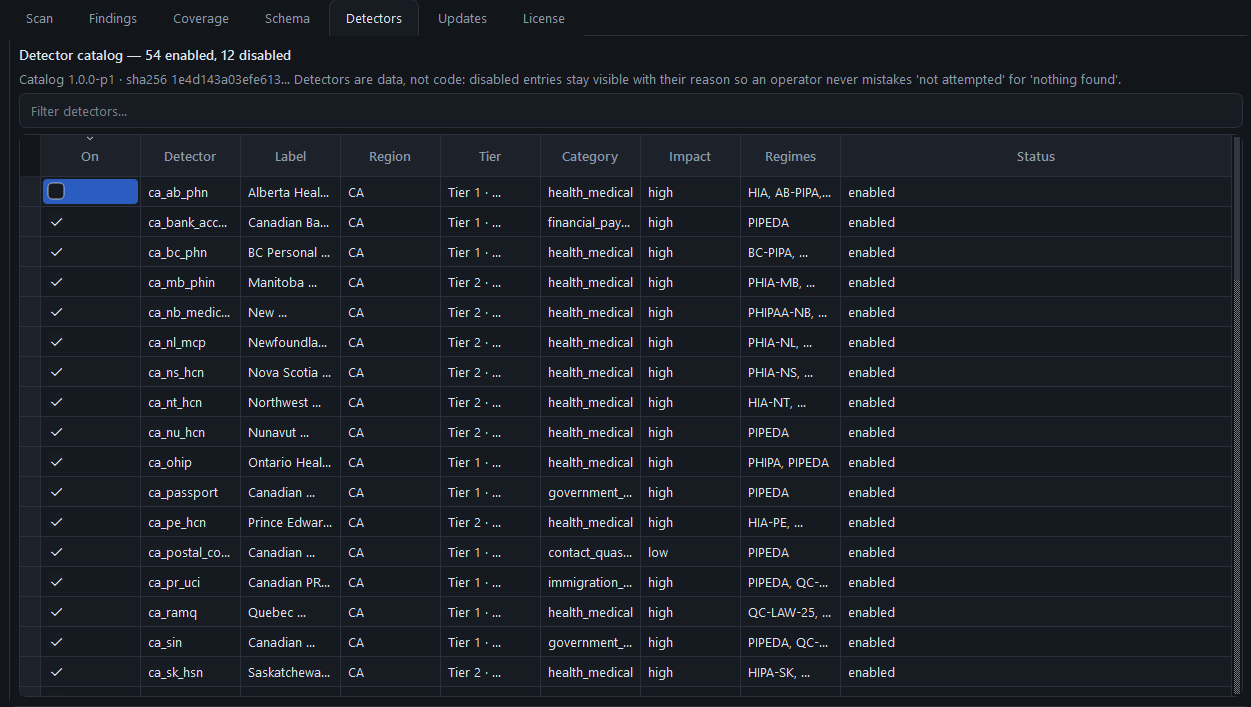
VellumSoft looks for Medicare MBI and NPI, along with SSN and ITIN, state driver's licences, US passports and ABA routing and bank account numbers. No separate detector for state Medicaid numbers is claimed here.
Detectors come in two tiers. Tier 1 detectors must pass a mathematical or structural check, and Tier 2 detectors report a value only when a nearby keyword or field name supports it.
CSV findings give the column and row, column headers act as context, and findings show masked values by default. For scanned cards, OCR reads images and scanned PDF pages, and a single misread character defeats a checksum. Version 2.0.2 does not read Word (DOCX), Excel (XLSX), ZIP or 7z files, and VellumSoft does not redact or delete what it finds.
Other identifiers are covered under all detectors by country, Social Insurance Numbers, Canadian health card numbers and the Ontario OHIP number format. The how it works page shows a scan from start to finish.
A claims export that nobody deleted is the usual place to find both numbers together. If one exists, it should be listed in the practice's risk analysis.
This page explains the law in general terms and is not legal advice.
Questions
How many characters is a Medicare MBI?
Eleven. CMS says the MBI has 11 characters, made of numbers and upper-case letters. The dashes printed on the card are not part of the number and are not entered into computer systems or used in file formats.
Does a Medicare MBI have a check digit?
The CMS format sheet describes none. It says each MBI is randomly generated and that its characters have no hidden or special meaning. What the format does have is a fixed pattern: certain positions are always letters and others are always numbers, which lets software rule out most random strings.
How many digits is an NPI?
Ten. The federal regulation defines the NPI as a 10-position numeric identifier with a check digit in the 10th position. CMS says the check digit is calculated with the Luhn formula.
Is an NPI confidential?
It is not designed to be. The regulation requires a covered provider to disclose its NPI, when requested, to any entity that needs it to identify the provider in a standard transaction. An NPI identifies a provider, not a patient. In files, it matters as a sign that claims or referral data is nearby.
Where do I find my own Medicare number?
On your Medicare card. This page is for organizations that hold other people's numbers in their files. For a question about your own MBI or a replacement card, contact Medicare directly.
Sources
- eCFR, 45 CFR 160.103, DefinitionsReviewed 16 Nov 2026