Safeguards Rule dealership compliance starts from one fact: a dealership that leases vehicles or arranges credit for buyers is a financial institution under the FTC Safeguards Rule, and must keep a written security program for every record of customer information, paper or electronic1. The Rule's own example is a dealership that leases automobiles for longer than 90 days1. The first practical job is finding where credit applications and licence copies are stored.
Is a car dealership a financial institution?
The Rule covers any business "significantly engaged" in a financial activity, and it gives examples. One of them is "an automobile dealership that, as a usual part of its business, leases automobiles on a nonoperating basis for longer than 90 days", which is a financial institution with respect to its leasing business1.
Financing reaches further than leasing. Among the Rule's examples of a customer relationship is a consumer who enters into an agreement under which the business undertakes "to arrange or broker a home mortgage loan, or credit to purchase a vehicle"1. Brokering loans is itself listed as a financial activity1. A dealership with a finance and insurance desk that sends credit applications to lenders is doing what those examples describe.
The line is drawn at the financial activity. The FTC's Privacy Rule says a motor vehicle dealer "is not a financial institution merely because it accepts payment in the form of cash, checks, or credit cards that it did not issue"2. A lot that sells only for cash sits on the other side of it. Whether a particular dealership is covered is a question about what it does, and one for counsel where the answer is not obvious.
What counts as customer information in a dealership
The Rule protects any record containing nonpublic personal information about a customer, "whether in paper, electronic, or other form"1. Its examples of that information map closely onto a deal file.
| The Rule's example1 | Where it appears in a dealership |
|---|---|
| Information a consumer provides on an application for a loan or other financial product | The credit application: SSN, date of birth, income, employer, address history |
| Information from a consumer report | The credit report pulled for the deal |
| Account balance and payment history | Payment records on leases and in-house contracts |
| The fact that an individual is or has been a customer | The customer list itself, including exports from the dealer management system |
| Any information obtained in connection with providing the financial product | Driver's licence copies, insurance cards and bank details collected for the file |
The second column is illustration, and the first is the Rule's wording1. The practical point is that a scan of a driver's licence saved to a salesperson's desktop is customer information once it was collected for a financed deal.
What the Rule requires of a dealership
The Rule requires a written information security program with a set of named elements: a Qualified Individual in charge, a risk assessment, safeguards that include access controls, encryption, multi-factor authentication and secure disposal, testing, staff training, oversight of service providers, an incident response plan and a yearly report to the board or a senior officer1. The FTC Safeguards Rule guide goes through each one, and the GLBA checklist workbook turns them into rows.
Four points matter most for dealers.
The Qualified Individual does not have to be a new hire. The Rule lets the role be filled by an employee, an affiliate or a service provider1. The FTC's 2021 notice records dealer trade groups commenting on the cost of the role, and cites a workshop speaker who said car dealerships can rely on existing staff for it3.
Smaller stores get partial relief. A financial institution that maintains customer information on fewer than five thousand consumers is excused from four provisions, covering the written risk assessment, scheduled penetration and vulnerability testing, the written incident response plan and the annual report1. The count is of consumers on file, and a store that has kept every deal since it opened may hold more than it thinks.
The dates have passed. The amended Rule took effect on January 10, 2022, and the provisions that were delayed began to apply on June 9, 202334. Secureframe's dealership article gives the same June 9, 2023 date5.
Breach notice goes to the FTC. When unencrypted customer information of at least 500 consumers is acquired without authorization, the Rule requires the institution to notify the Federal Trade Commission as soon as possible, and no later than 30 days after discovery1. Secureframe's article describes this as a duty to notify affected consumers within 30 days5. The Rule's paragraph names the Commission as the recipient1. Consumer notice is a matter for state breach laws, such as the one covered in the NY SHIELD Act guide.
Vendor material also blurs who is covered. Securiti's whitepaper page says the amendment means the Rule "now applies to all customer information held by non-financial institutions"6. The Rule's scope paragraph speaks of financial institutions, a term its definitions stretch to include businesses outside banking, such as a dealership that leases1.
The FTC Privacy Rule and auto dealers
Dealers are the one group the FTC's own Privacy Rule is written for. The scope paragraph of the FTC's Privacy Rule says the institutions subject to it are persons "predominantly engaged in the sale and servicing of motor vehicles, the leasing and servicing of motor vehicles, or both"2. It excludes certain dealers that directly extend retail credit or retail leases without routinely assigning the contracts to an unaffiliated finance source2.
The Privacy Rule is about notices and sharing. It requires an initial privacy notice, an annual notice to customers, and an opt-out before nonpublic personal information is disclosed to nonaffiliated third parties, with exceptions such as processing a transaction the consumer asked for2. It sets no security controls. Those are in the Safeguards Rule.
Where customer data hides in a dealership
The dealer management system is the place everyone names. The Rule's inventory duty covers the data, personnel, devices, systems and facilities that the business relies on, so it reaches the copies outside that system as well1:
- scanned deal jackets saved as PDFs on a shared drive
- photos of driver's licences and insurance cards on sales and service PCs
- credit applications emailed to or from lenders, sitting in staff mailboxes and mailbox exports
- CSV exports of customer and lead lists from the dealer management system or the CRM
- files on the PCs of departed finance managers and salespeople
- old paper deal files scanned in bulk before a storage clean-out.
The disposal clause applies to all of them. The Rule calls for secure disposal of customer information no later than two years after it was last used to provide a product or service to the customer, unless a business purpose or a law requires keeping it1.
A worked example, with synthetic data
A two-rooftop dealer group is preparing its yearly review. All names and values here are made up.
- Scope. The controller, who is the Qualified Individual, lists the shared drive, the finance office PCs, the sales floor PCs and the mailbox exports of two former finance managers.
- Scan. A technician scans those locations from one workstation, with OCR on because most deal paperwork is scanned.
- Coverage. The technician reads what was not read first. A folder of form letters in a word-processor format and a set of compressed backups are listed, and are recorded as an open gap.
- Findings. High-impact findings come first: Social Security numbers and driver's licence numbers in scanned credit applications under a "Deals" folder, and bank account and routing numbers in a CSV export on a former manager's desktop.
- Decisions. Deal scans past the group's retention period are deleted, current ones move into the document system, and the stray export is removed.
- Record. The inventory is updated and the report is filed with the risk assessment.
How VellumSoft fits a dealership
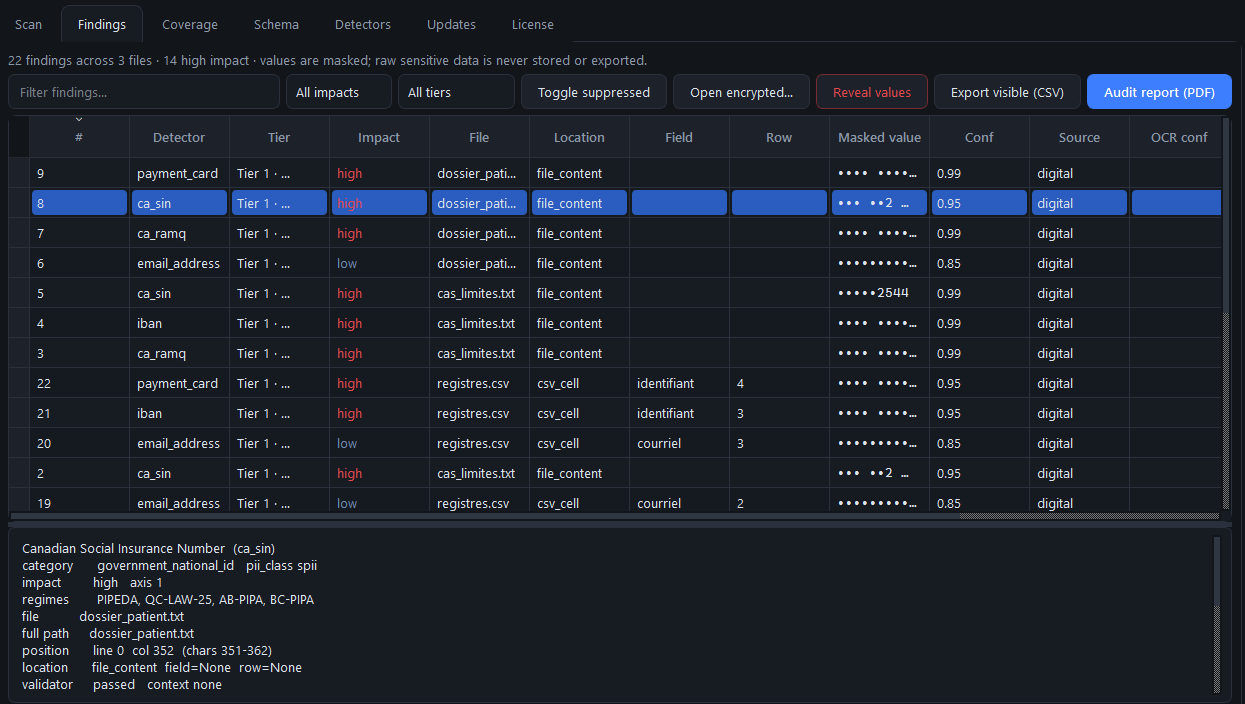
VellumSoft scans PST and email exports, documents and images for US and Canadian PII and PHI, and scanned data and findings are never transmitted. The identifiers it looks for include SSN and ITIN, state driver's licences, ABA routing and bank account numbers, and VINs. OCR reads scanned PDF pages and images, and OCR findings are less reliable than digital text. The Social Security number page explains how a nine-digit number is confirmed by context.
The limits shape the job. Version 2.0.2 does not read Word (DOCX), Excel (XLSX), ZIP or 7z files. It has no connector for a dealer management system, a CRM or any other database; the scanner reads exported files and mail archives. VellumSoft does not block, quarantine, redact or delete, so removing a file is done in the dealership's own systems. Results are not a guarantee that every instance in a data set will be found.
VellumSoft Solo is $399 per seat and VellumSoft Team is $749, each a one-time payment. Licence terms are on the pricing page.
Related pages: PII scanning for MSPs, the tax and accounting page, PHI scanning for clinics and law firms.
A deal jacket scanned to a shared drive holds everything the Rule's definition lists, in one PDF1.
This page explains the law in general terms and is not legal advice.
Questions
Does the FTC Safeguards Rule apply to auto dealers?
It applies to a dealership that is significantly engaged in a financial activity. The Rule's own example is an automobile dealership that, as a usual part of its business, leases automobiles on a nonoperating basis for longer than 90 days. The Rule also treats arranging or brokering credit to purchase a vehicle as creating a customer relationship.
Does a small independent dealer have to comply?
Yes, with a lighter load. A financial institution that maintains customer information on fewer than five thousand consumers is excused from the written risk assessment, scheduled penetration and vulnerability testing, the written incident response plan and the annual board report. The rest of the Rule applies at any size.
Must a dealership report a data breach to the FTC?
Yes, when unencrypted customer information of at least 500 consumers is acquired without authorization. The Rule requires notice to the FTC as soon as possible and no later than 30 days after discovery, through a form on the FTC's website.
What is the FTC Privacy Rule for auto dealers?
It is the FTC's rule on privacy notices and limits on sharing nonpublic personal information. Its scope paragraph says it applies to businesses predominantly engaged in the sale and servicing or the leasing and servicing of motor vehicles, with an exclusion for certain dealers that extend retail credit or leases directly.
Sources
- eCFR, 16 CFR Part 314, Standards for Safeguarding Customer InformationReviewed 16 Nov 2026
- eCFR, 16 CFR Part 313, Privacy of Consumer Financial InformationReviewed 16 Nov 2026
- Secureframe, FTC Safeguards Rule for auto dealershipsReviewed 16 Nov 2026
- Securiti, Achieving Compliance With The Amended Safeguards Rule 2022Reviewed 16 Nov 2026