A Social Security number (SSN) is nine digits written in three groups, 000-00-00001. It has no check digit to test, and since June 25, 2011 the digits are assigned at random, so a scan for SSNs has to use context such as a column named "SSN"12. This page is for the employer or IT person who found SSNs on a drive. For your own number, go to the Social Security Administration at ssa.gov.
What the digits of an SSN mean
The Social Security Administration's operations manual describes the old structure1. Before June 25, 2011, the first three digits were the area number, which reflected the state of the mailing address on the application1. The middle two digits were the group number, from 01 to 99, and the last four were a serial number running from 0001 to 99991.
Since June 25, 2011, SSA assigns all SSNs randomly and no longer allocates area numbers to states2. In SSA's own words, "this structure is no longer of any significance" for numbers issued from that date on1. The first three digits of a newer number say nothing about where the holder lived.
Why a bare nine-digit number is hard to confirm
SSA's description of the structure mentions no check digit1. SINs and payment card numbers carry a Luhn check that rejects random digits (see the SIN guide). The SSN structure has nothing like it1. Any nine-digit number in the 000-00-0000 shape could be an SSN, a phone extension, an order number or an invoice reference1.
The IRS issues a second nine-digit number, the individual taxpayer identification number (ITIN), to people who need a US taxpayer identification number but are not eligible for an SSN3. Tax files often hold both. A useful SSN search therefore looks for the words around the number: a column headed "SSN" or "Social Security", a label on a form, or the phrase "social security" in the same line.
Where SSNs turn up in an organization's files
The FTC notes that most companies keep sensitive personal information in their files, including names and Social Security numbers, often because it is needed to meet payroll4. The places it ends up are predictable:
- payroll and benefits exports saved as CSV files on a shared drive
- scanned new-hire paperwork and tax forms saved as PDFs
- old mailboxes exported to PST files, with forms attached to messages
- photos of ID documents taken on a phone and synced to a laptop
- test copies of a production database left on a developer's machine.
The FTC tells businesses to inventory computers, laptops, flash drives, digital copiers and other equipment to find where sensitive data is stored, and adds that "no inventory is complete until you check everywhere sensitive data might be stored"4.
What the FTC asks of a business that holds SSNs
The FTC's guide is direct about SSNs. It says to use Social Security numbers "only for required and lawful purposes" such as reporting employee taxes, and not as an employee or customer ID number4. It says to limit access to employees with a need to know, and to caution staff against sending SSNs by email, because "unencrypted email is not a secure way to transmit information"4. Data with no business reason to keep it should be disposed of properly4.
Some businesses face a binding rule as well. The FTC's Safeguards Rule names tax preparation firms among the financial institutions it covers, and its definition of customer information includes records "in paper, electronic, or other form"6. The Rule requires those firms to identify and manage the data that enables their business purposes6.
Masking does not take a number out of scope. NIST says partial identifiers, such as the last few digits of an SSN, are often considered PII because they are still nearly unique identifiers5.
How to search files for Social Security numbers
A manual search for the 000-00-0000 pattern catches numbers typed with hyphens and misses the rest1. A workable search covers three things:
- Formats: numbers with hyphens, with spaces and with no separators at all.
- Context: a label such as "SSN", "Social Security" or "Soc Sec" near the number, or a column header in a CSV export.
- Containers: text files and CSV exports, PDFs (including scanned pages that need OCR), images, and mail archives.
Finding SSNs with VellumSoft
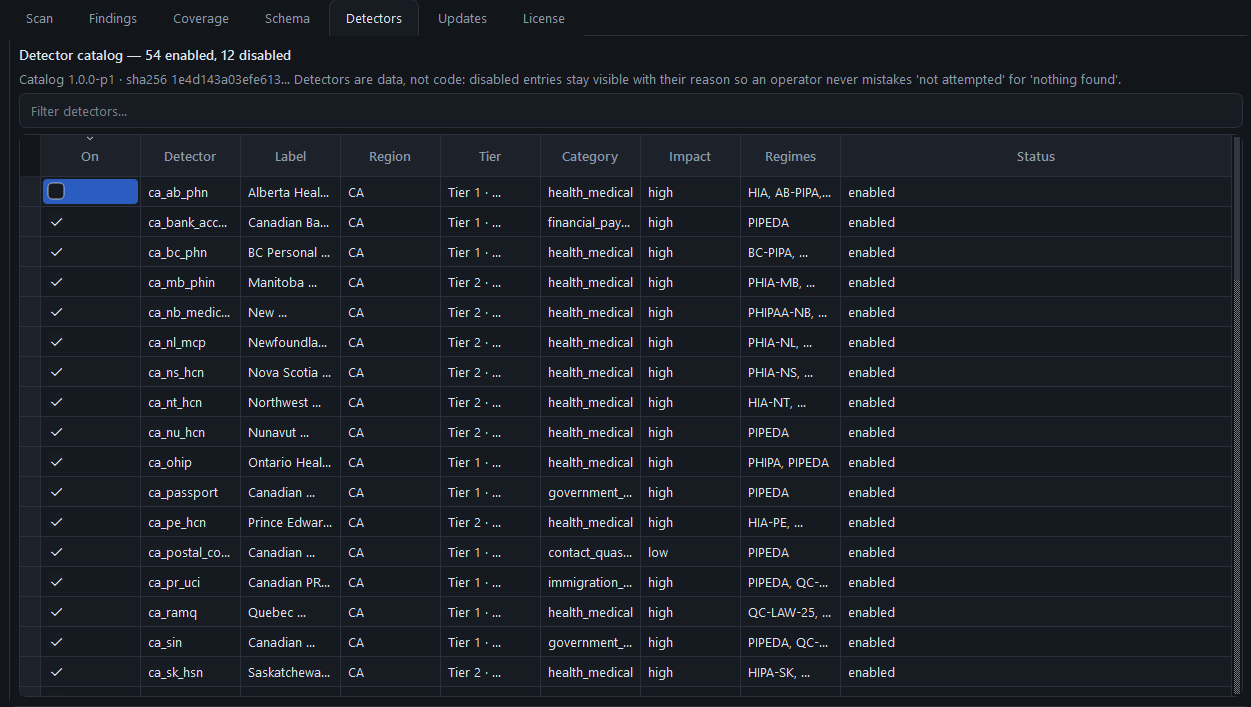
The screenshot shows the catalog's count line and its Canadian rows. The US detectors, SSN included, sit in the same catalog.
VellumSoft looks for SSNs and ITINs, along with Medicare MBI, NPI, state driver's licences, US passports and ABA routing and bank account numbers. The Region setting (US, CA or BOTH) limits detectors to the chosen jurisdictions.
A bare nine-digit number without surrounding context is reported with a confidence score rather than asserted as a match. Findings show masked values by default, and the results file and audit report never hold raw values. For mail, a finding shows the message's folder and sender, its date and subject, plus the attachment name, which is how an SSN in a forwarded form gets traced back to its message (see PST, OST and MSG scanning).
The limits matter for SSNs in particular. Version 2.0.2 does not read Word (DOCX), Excel (XLSX), ZIP or 7z files, and OCR can misread characters. VellumSoft does not redact or delete. Removing an SSN from a file happens in the file's own system. Other identifiers are covered under all detectors by country and Canadian health card numbers.
An SSN found in a payroll export from years ago is usually best deleted, since the FTC's test is whether a business reason to keep it still exists4.
This page explains the law in general terms and is not legal advice.
Questions
What do the digits of a Social Security number mean?
Before June 25, 2011, the first three digits were the area number tied to the state of the mailing address, the middle two were the group number and the last four were the serial number. The Social Security Administration says that for numbers issued from that date on, the structure is no longer of any significance.
Are the last four digits of an SSN still PII?
Often, yes. NIST says partial identifiers, such as the first few or last few digits of an SSN, are often considered PII because they are still nearly unique and linked or linkable to a specific person. A masked report that shows the last digits should still be handled as confidential.
Can an employer keep employee SSNs in email?
The FTC's guide for business tells employers to caution staff against sending Social Security numbers by email, because unencrypted email is not a secure way to transmit information. It also says to keep sensitive data only as long as there is a business reason for it.
I need help with my own Social Security number. Where do I go?
This page is for organizations that hold other people's numbers. For a lost card, a replacement or a question about your own number, go to the Social Security Administration at ssa.gov.
Sources
- Internal Revenue Service, Individual taxpayer identification number (ITIN)Reviewed 16 Nov 2026
- eCFR, 16 CFR Part 314, Standards for Safeguarding Customer InformationReviewed 16 Nov 2026