A law firm keeps client personal information in closed-matter folders, scanned exhibits and old mailbox exports, and its conduct rules require it to protect all of it. A PII scanner reports which files hold identifiers so the firm can secure them or dispose of them. That is a different job from e-discovery, which Microsoft defines as "the process of identifying and delivering electronic information that can be used as evidence in legal cases"7.
The rules that bind a law firm's own files
Every lawyer knows the confidentiality rule. Fewer firms have applied it to a file server.
| Rule | Where it is | What it asks |
|---|---|---|
| Confidentiality, Ontario | Rule 3.3-11 | Hold "in strict confidence all information concerning the business and affairs of the client"1 |
| Competence, Ontario | Commentary to rule 3.1-21 | Understand the benefits and risks of relevant technology, "recognizing the lawyer's duty to protect confidential information"1 |
| Confidentiality, Washington State | RPC 1.6(c)3 | "Make reasonable efforts to prevent the inadvertent or unauthorized disclosure of, or unauthorized access to, information relating to the representation of a client"3 |
| Competence, Washington State | Comment to RPC 1.14 | Keep abreast of "the benefits and risks associated with relevant technology"4 |
| Privacy law, Canada | PIPEDA, as explained in the OPC's handbook for lawyers5 | Safeguard personal information at all times, and keep it only as long as necessary5 |
The Ontario duty does not expire. The Law Society of Ontario's commentary says it "continues indefinitely after the lawyer has ceased to act for the client"1. A matter closed years ago is still covered, and so is the scanned passport in its folder.
Washington's rule is one state's text, quoted here as an example. Each US state adopts its own rules, so a firm should read its own. Washington's comment lists the factors that make efforts reasonable, including "the sensitivity of the information" and "the cost of employing additional safeguards"3. The same comment says whether data privacy or breach notification laws demand more "is beyond the scope of these rules"3. The conduct rule is a floor.
In Canada, privacy law sits on top. The Office of the Privacy Commissioner says PIPEDA applies to organizations that collect, use or disclose personal information in the course of commercial activities, and that "this would include private sector lawyers and law firms"5. Its handbook adds that "the more sensitive the information is, the stronger the safeguards must be"5. The Law Society of Ontario's technology guideline names the risk plainly: "theft of vast amounts of electronic information stored in stolen hardware"2.
Where client PII hides in a firm
The practice-management system is the tidy part. The rest collects in copies:
- client identification records, which the OPC notes law society requirements may oblige a firm to collect when securing a retainer5
- closed-matter folders with scanned ID, medical briefs, tax returns and bank statements
- mailbox exports left behind when a lawyer departs, often as
.pstfiles on a shared drive - productions received from the other side, which hold personal information about people who are not the firm's clients at all
- scanned exhibits and intake forms saved as image-only PDFs.
The OPC makes the point about non-parties directly. In litigation, the individuals affected are often not parties, for example "where a corporate litigant's employee or customer personal information is involved"5. A firm that acts for a company in an employment dispute may be holding a payroll export for the whole workforce.
What is e-discovery, and why a PII scan is not it
Everlaw describes e-discovery as "an integral part of the litigation process"8. The work runs matter by matter. Logikcull's product page describes that span as running "from automated hold notices to three-step productions"9. Microsoft's Purview tools follow the same shape: search for content, place locations on legal hold, review, export7.
The hold is the step with a rule behind it. In US federal courts, Rule 37(e) of the Federal Rules of Civil Procedure applies when electronically stored information "that should have been preserved in the anticipation or conduct of litigation is lost because a party failed to take reasonable steps to preserve it", and it cannot be restored or replaced through additional discovery6. If the court finds intent to deprive the other side, it may presume the lost information was unfavourable, or dismiss the action6. The committee notes say many court decisions hold that potential litigants have a duty to preserve relevant information "when litigation is reasonably foreseeable"6.
VellumSoft is not e-discovery software and it is not legal-hold software. It has no hold notices, custodian tracking, review or production. It is a discovery tool in the data sense, where discovery means finding data, not litigation discovery.
E-discovery vs DLP vs a PII scan
| E-discovery | DLP | PII scan | |
|---|---|---|---|
| Question it answers | What evidence is held for this matter? | Is someone sharing sensitive data they should not? | Which files hold personal identifiers? |
| When it runs | When a dispute or investigation starts7 | Continuously, as users work10 | At intervals the firm sets, or before a move or after an incident |
| Typical output | A preserved, reviewed set of documents for production9 | A blocked or flagged action10 | A list of files and locations, with the data type found in each |
Microsoft describes DLP as a way to "help prevent their users from inappropriately sharing sensitive data with people who shouldn't have it"10. It acts on what users do with data as they work. A scan looks at what has already piled up.
A worked example, with synthetic data
Take a small firm clearing out a departed associate's mailbox export and one closed-matters folder. Everything below is made up.
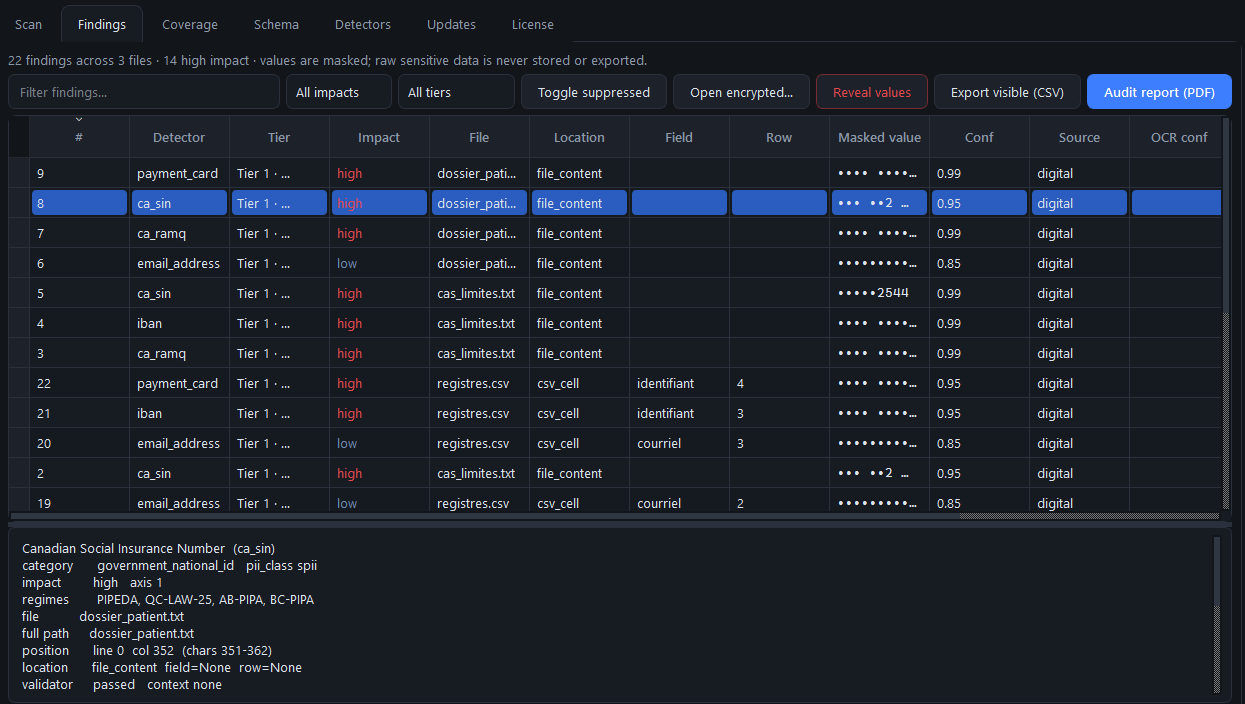
VellumSoft reads .pst, .ost and .msg archives, with each attachment scanned as its own file type, along with PDFs, CSV files and images. Scanned pages are read only when OCR is on. In this example, with OCR on, the scan reports a Social Insurance Number in a scanned retainer form, health card numbers in a medical brief attached to an email, and a column of bank account numbers in a CSV export from the accounting system. Each finding shows a masked value, and a finding from mail shows the attachment name plus the folder, sender, date and subject.
Then comes the part a law firm must not skip. Version 2.0.2 does not read Word (DOCX), Excel (XLSX), ZIP or 7z files, and lists them as unsupported on its Coverage tab. Most of a matter folder is exactly that kind of file. Convert the files in scope to PDF and scan again, or record them as a gap. A report with no findings on a folder of unread drafts says nothing about those drafts.
One feature matters for confidentiality. The scan runs locally, and scanned data and findings are never transmitted, so client files are not handed to another vendor. The results file is itself sensitive, since it shows which files hold which kinds of data.
What to do with what the scan finds
VellumSoft does not delete, redact or quarantine anything. The firm acts on the findings in its own systems. The OPC's advice to lawyers is to keep personal information "only for as long as is necessary", while retaining what could be needed to defend against a future negligence claim5.
Check for a hold before disposing of anything. A scan finding is not permission to delete, and Rule 37(e) is the reason6.
The PST and mailbox scanning page covers mail archives, and how a scan works covers the steps from scope to report. There are matching pages for clinics and health custodians, for MSPs, for tax preparers and accounting firms and for auto dealers. Licensing is on the pricing page.
This page explains the law in general terms and is not legal advice.
Questions
Is VellumSoft e-discovery software?
No. E-discovery software manages evidence for a legal matter: holds, collection, review and production. VellumSoft reports where personal and health identifiers sit in files and mail archives. It has no hold notices, no document review and no production.
What is a litigation hold?
It is the step of preserving information once litigation is reasonably foreseeable. The committee notes to Federal Rule 37 say many court decisions hold that potential litigants have a duty to preserve relevant information from that point. A hold notice tells the people who have the information to stop deleting it.
Does PIPEDA apply to Canadian law firms?
The Office of the Privacy Commissioner of Canada says PIPEDA applies to organizations that collect, use or disclose personal information in the course of commercial activities, and that this would include private sector lawyers and law firms. Firms that collect, use or disclose personal information entirely within Alberta, British Columbia or Quebec fall under those provinces' laws instead, although PIPEDA continues to apply to transfers across provincial or national borders.
Can a scan finding be deleted straight away?
Not before two checks. The firm's file retention rules may require the record to be kept, and a legal hold may cover it. In US federal courts, under Federal Rule 37, a party that fails to take reasonable steps to preserve electronically stored information for litigation can face court-ordered measures.
Sources
- Law Society of Ontario, Practice Management Guideline: TechnologyReviewed 16 Nov 2026
- Washington Courts, Rules of Professional Conduct, RPC 1.1 Competence (PDF)Reviewed 16 Nov 2026
- Microsoft Learn, Microsoft Purview eDiscovery solutionsReviewed 16 Nov 2026
- Everlaw, What Is Ediscovery?Reviewed 16 Nov 2026
- Logikcull, eDiscovery for LitigationReviewed 16 Nov 2026
- Microsoft Learn, Learn about data loss preventionReviewed 16 Nov 2026