A PCI DSS scanner can mean two different things. One is the external vulnerability scan run by an Approved Scanning Vendor5. The other is a card data discovery scan, which looks inside files for card numbers that ended up outside the cardholder data environment. This page covers the second: a local, one-time check of shared drives, workstations and old mailboxes before an assessment, so the scope on paper matches the files on disk.
The trigger: confirming scope before the assessment
Every PCI DSS assessment starts with scope. The council's glossary definition, quoted in its scoping guidance, says "The first step of a PCI DSS assessment is to accurately determine the scope of the review"1.
The same guidance, an information supplement dated May 2017 that cites PCI DSS v3.2, says who does that work and when1. "At least annually and prior to the annual assessment, the assessed entity should confirm the accuracy of its PCI DSS scope by identifying all locations and flows of cardholder data"1. The entity also keeps documentation that shows how scope was determined, and that documentation "is retained for assessor review"1.
The awkward word in that sentence is "all". A payment system's own database is the location everyone knows. The locations nobody lists are a refund request with a card number typed into an email, a scanned authorization form on the accounts share, and a CSV export a developer pulled two years ago.
What the assessor asks for
The guidance splits the job in two. The entity determines scope and confirms its accuracy each year. The assessor then validates "that the scope of the assessment is accurately defined and documented", and "should question scoping decisions" that are not clear from the entity's documentation1.
On stored data, the council's Quick Reference Guide sets out the rules behind an assessor's questions3:
- Is cardholder data stored only where the business needs it? The guide says to "Limit cardholder data storage and retention time" and to "Purge unnecessary stored data at least quarterly"3.
- Is any sensitive authentication data kept after authorization? The answer has to be no, "even if it is encrypted"3.
- Is stored PAN unreadable wherever it sits? The guide says to "Render PAN unreadable anywhere it is stored"3.
That guide covers version 3.2.1 of the standard, and the scoping guidance cites v3.213. The council says v4.0.1 became the only active version after 31 December 2024, so use the current standard for wording and numbering6.
How stray card data widens PCI DSS scope
The cardholder data environment, or CDE, is defined by where the data is. The glossary says it is made up of the system components, people and processes "that store, process, or transmit cardholder data and/or sensitive authentication data"2. A file server with one folder of card numbers on it is, by that definition, storing cardholder data.
Encryption does not undo that. The council says "encryption alone is generally insufficient to render the cardholder data out of scope for PCI DSS", and that the environment "is still in scope for PCI DSS due to the presence of cardholder data"4.
Scope reduction therefore begins with finding and removing data that has no reason to exist. The scoping guidance says risk is "reduced by consolidating cardholder data into fewer, more controlled locations"1. Nobody can consolidate copies they have not found.
Compliance levels and small businesses
Many checklists open with a table of merchant levels by transaction count, as Lepide's does for Visa and Mastercard10. The levels belong to the card brands. The council's own answer is that whether a small merchant must validate compliance "is determined by the individual payment brands", and that merchants should contact their acquirer4.
The standard itself applies either way. The council says PCI DSS is intended for all entities involved in payment processing, including merchants, "regardless of their size or transaction volume"4. A five-person office that takes cards over the phone is held to the same standard as a national retailer. It has far fewer places to look.
How a local scan answers the scope question
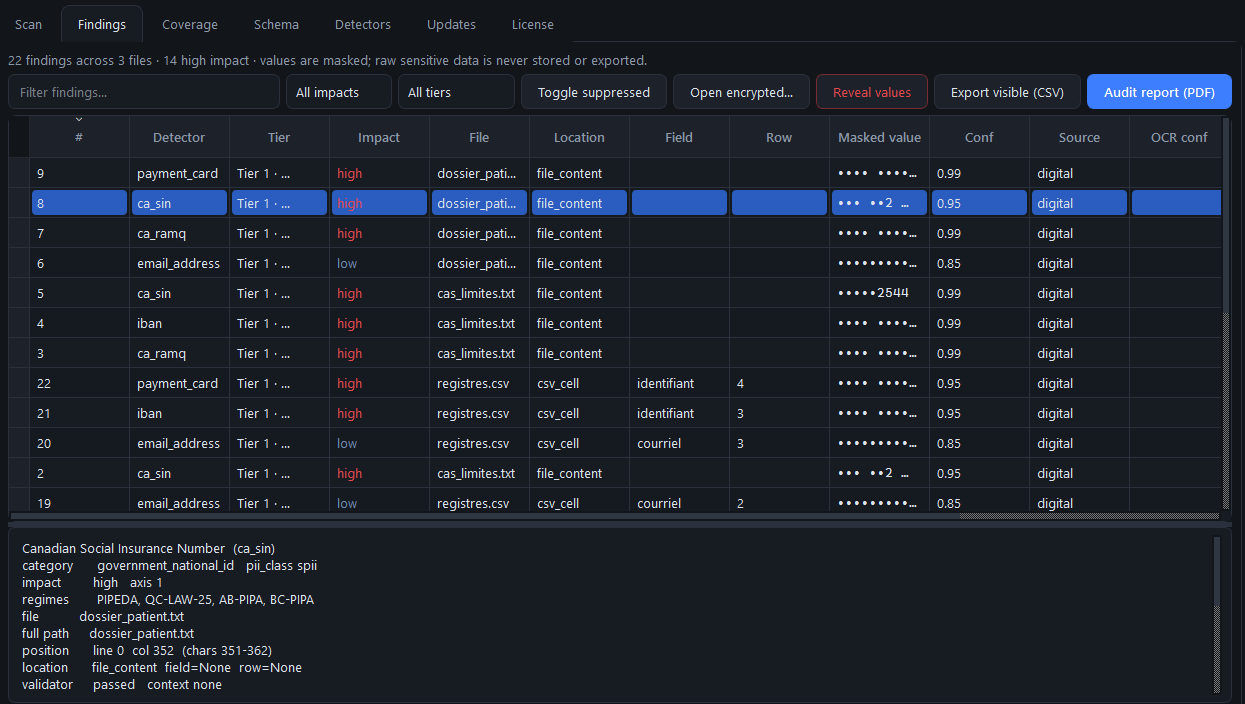
VellumSoft looks for payment card numbers, and scanned data and findings are never transmitted. Payment cards are a Tier 1 detector, which means a match has to pass the Luhn check before it is reported. The mechanics are on the payment card detector page.
A pre-assessment check looks like this:
- List the places outside the CDE where card data could have leaked: finance and customer service shares, the workstations of anyone who takes payments, and exported mailboxes.
- Scan each as a folder, with OCR on where scanned forms are kept. PST, OST and MSG mail files are read with their attachments.
- Read the Coverage tab first. Version 2.0.2 does not read Word (DOCX), Excel (XLSX), ZIP or 7z files, and card authorization forms are often kept in exactly those formats, so the list of unread files is part of the answer.
- Filter the findings to the payment card detector and sort by file.
- Clean up at the source, then scan the same scope again to show the reduction.
For email, each finding shows the message's folder, sender, date and subject, plus the attachment name. That is what a mailbox clean-up needs, because the message has to be found and deleted in the mail client. VellumSoft does not delete or redact anything itself.
The report it produces
The audit report is a PDF with an executive summary, the scan scope and timestamp, counts per data type with validation results, file-level locations, and a coverage disclosure of what the scan could not read. It also carries a SHA-256 fingerprint of the exact results it was built from.
Two properties suit card data. The report and the results file never hold raw values, so the evidence of where card numbers were does not become a new copy of them. And the coverage disclosure states plainly what was not read, which is the question an assessor is entitled to ask of any discovery method.
The regimes named on findings are privacy laws, and a PCI DSS label on card findings is not covered here. No scan settles scope alone. No scanner finds everything, and a file scan says nothing about databases, memory or network traffic.
VellumSoft Solo is $399 per seat and Team is $749, each a one-time payment. The current terms are on the pricing page.
When another tool is the better pick
This is a crowded field, and the larger tools do more.
Ground Labs describes Card Recon as a cardholder data discovery tool with desktop and server editions, remediation options, and scanning of local memory and free disk space7. ManageEngine describes periodic and incremental discovery scans across file servers, with file management actions built in8. Secureframe's checklist folds the inventory of account data storage locations into a gap assessment, run with its platform or a consultant9.
Pick one of those when card data has to be remediated inside the tool, when Linux servers or databases are in scope, or when scanning must run continuously. A local scan fits the narrower case: a small or mid-sized organization, Windows file shares and mail archives, one person, and a need to check before the assessor does without sending files to a cloud service.
Related checks use the same method for other data: finding ePHI for a HIPAA risk analysis, breach scoping (breach scoping), old PST files before a Microsoft 365 import and a personal data inventory (personal data inventory).
Start with the mailbox of whoever has handled refunds the longest.
This page explains the standard in general terms and is not legal advice.
Questions
Is cardholder data discovery a requirement in PCI DSS 4.0?
The council's scoping guidance, dated May 2017 and written against PCI DSS v3.2, does not name a discovery tool. It says the entity should confirm its scope at least annually, and before the annual assessment, by identifying all locations and flows of cardholder data. How those locations are identified is left to the entity. Check the exact wording and requirement number in the current standard in the council's document library.
What are the PCI DSS compliance levels?
The levels are set by the card brands, not by the PCI Security Standards Council. The council says whether a small merchant has to validate compliance is determined by the individual payment brands, and that merchants should ask their acquirer or the payment brand they do business with.
Does PCI DSS apply to a small business?
Yes. The council says PCI DSS is intended for all entities involved in payment processing, including merchants, regardless of their size or transaction volume. It adds that small merchants often have simpler environments, with limited amounts of cardholder data and fewer systems to protect, which can reduce the effort.
Does encrypting card numbers take a system out of PCI DSS scope?
Not by itself. The council says encryption alone is generally insufficient to render cardholder data out of scope, and that the environment is still in scope due to the presence of cardholder data. Removing card data that has no business reason to exist is what shrinks the number of places to protect.
What is the difference between PII, PHI and PCI data?
PII is information that identifies a person, PHI is health information tied to a person under HIPAA, and PCI data is cardholder data under the card industry's standard. They overlap. A card number beside a name is cardholder data to an assessor and personal information under many privacy laws at once.
Sources
- PCI Security Standards Council, GlossaryReviewed 16 Nov 2026
- PCI Security Standards Council, Merchant Resources and FAQsReviewed 16 Nov 2026
- PCI Security Standards Council, PCI Data Security Standard (PCI DSS)Reviewed 16 Nov 2026
- PCI Security Standards Council, Just Published: PCI DSS v4.0.1Reviewed 16 Nov 2026
- Ground Labs, Card ReconReviewed 16 Nov 2026
- ManageEngine DataSecurity Plus, PCI DSS compliance reporting toolReviewed 16 Nov 2026
- Secureframe, PCI compliance checklistReviewed 16 Nov 2026
- Lepide, What is PCI Compliance? The 12 Requirements and ChecklistReviewed 16 Nov 2026