An Ontario health number, often called an OHIP number, is a 10-digit number that stays with a person for life1. On a photo health card it is followed by a two-letter version code, which identifies that particular card2. Older red and white cards may show no version code, one letter or two2. A replacement card keeps the same health number and gets a new version code3.
As a pattern, with N for a digit and V for a letter, that is NNNNNNNNNN VV. It is a pattern, not a number.
What the 10 digits and the version code mean
The Ministry of Health calls the health number a "unique 10-digit lifetime identification number", assigned to all eligible Ontario residents1. The ministry's manuals describe it only as an identifier. They do not say that any digit stands for a birth date, a region or a sex.
The version code is a separate thing. The ministry's technical specification defines it as "an alphabetic identifier that along with the health number uniquely identifies a health card version"2. The validation manual gives the reason it exists: "Version codes were introduced to uniquely identify a health card and allow the ministry to verify the status of a health card to reduce fraud"1.
| Card | Health number | Version code |
|---|---|---|
| Photo health card | 10 digits1 | Two letters2 |
| Red and white health card | 10 digits1 | None, one letter or two letters2 |
Individual health numbers and the red and white card date from 19903. The photo card followed in 19951. Both remain acceptable as proof of entitlement if the card is valid and belongs to the person presenting it3.
When the version code changes
The ministry says that in most cases, "when a change in information is made or the card is reported lost, stolen, damaged or not received, a replacement card will be issued with the same health number and a new version code"3. On red and white cards the version code appears on replacement cards only3.
This matters for anyone reading old records. A photocopy of a card taken years ago can show a version code that is no longer current, while the 10 digits beside it still point to the same person13. A stale version code does not make the copy harmless.
Is there a check digit?
The ministry documents read for this page do not publish a check-digit formula, but one response identifier in them points to a modulus 10 test2. The validation service answers with response code 05, identifier NOT_10_DIGITS, when the submitted number is not 10 numeric digits2. It answers with response code 10, identifier FAILED_MOD10, for a submitted number that does not exist on the ministry's system2.
The same specification gives the accepted shape as a pattern. The health number is ten digits with a first digit from 1 to 9, and the version code is up to two capital letters2.
Passing a shape test is not the same as being a real number. The validation manual lists the edit checks the ministry runs, and one of them is that the "10-digit health number has been issued by the ministry"1. Only the ministry's database can answer that.
Where OHIP numbers turn up in files
Inside a clinic the number is everywhere it is meant to be: billing claim files, referral letters, lab requisitions and intake forms scanned to PDF. Those are expected, and the work there is knowing which folders and mailboxes hold them.
The harder cases sit outside health care. An employer's benefits folder with photocopied cards. A school or camp registration export with a health card column. A decade-old mailbox export where a parent emailed a photo of a child's card. In each one the number arrives with a name and often a date of birth, which is what makes the copy sensitive.
Who may ask for the number
PHIPA treats the pieces as one. It defines "health number" as "the number, the version code or both of them"4, and the ministry notes that a person's health number and version code are personal health information under that Act3.
Section 34 then limits who may ask4. "No person shall require the production of another person's health card", except a person who provides a provincially funded health resource to the cardholder4. A person who is neither a health information custodian nor a custodian's agent "shall not collect or use another person's health number" except for the listed purposes4. A clinic billing the province is covered. An employer or landlord that kept card photocopies as identification should ask which listed purpose, if any, covers keeping them.
The wider rules for custodians are on the PHIPA in Ontario page, and the other provinces are compared in Canadian health card numbers.
Finding OHIP numbers with VellumSoft
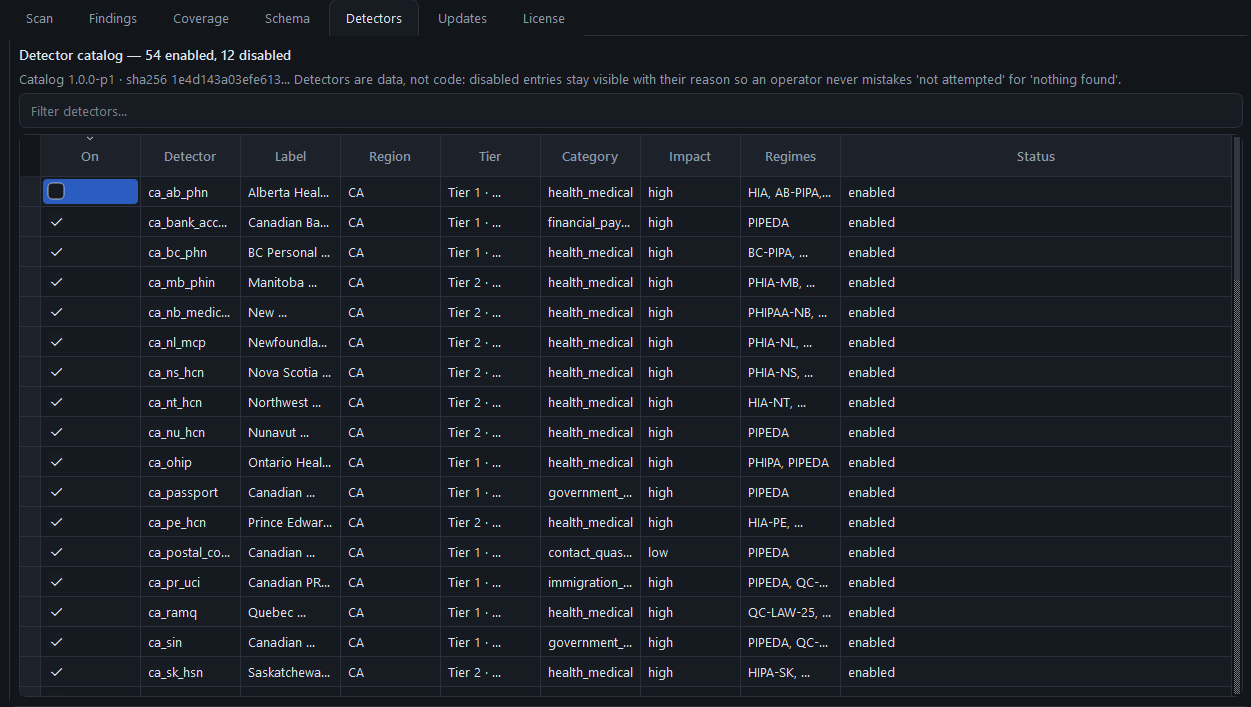
Ontario (OHIP) health numbers are among VellumSoft's Canadian identifiers. The OHIP detector is Tier 1 and high impact, and a Tier 1 match must pass a mathematical or structural check.
The limits matter for health cards in particular. Version 2.0.2 does not read Word (DOCX), Excel (XLSX), ZIP or 7z files. Photocopied cards are images, so they depend on OCR, and a single misread character defeats a checksum. VellumSoft does not redact or delete, so removing a copy happens in the system that holds it.
The steps of a scan are set out on the how it works page. Related identifiers have their own pages: Social Insurance Numbers, US Social Security numbers, the Quebec RAMQ number and the full detector list by country.
For a patient, the short version is that the 10 digits are yours for life and the letters change with each card13. For an office holding old copies, the version code on the copy may be out of date but the number is not.
This page explains the law in general terms and is not legal advice.
Questions
How many digits is an OHIP number?
Ten. The Ministry of Health describes the health number as a unique 10-digit lifetime identification number assigned to every eligible Ontario resident. The letters that follow it on most cards are the version code, which identifies the card and is not part of the 10 digits.
What is the version code on an Ontario health card?
It is an alphabetic identifier that, together with the health number, identifies one specific card. Photo health cards carry a two-letter version code. Red and white cards may have no version code, one letter or two letters. The ministry introduced version codes so it could verify the status of a card and reduce fraud.
Does my OHIP number change when I get a new card?
No. The ministry says that in most cases, when information changes or a card is reported lost, stolen, damaged or not received, the replacement card is issued with the same health number and a new version code. The number is meant to stay with a person for life.
Can an employer in Ontario ask for my health card?
PHIPA says no person shall require the production of another person's health card, unless that person provides a provincially funded health resource to the cardholder. Someone who is not a health information custodian may collect or use a health number only for the purposes the Act lists.
Is there a check digit in an Ontario health number?
The ministry's validation service has a response code 10 whose identifier is FAILED_MOD10, which points to a modulus 10 test. The ministry documents read for this page do not publish the formula. They do say a number must be 10 numeric digits and must have been issued by the ministry.