Driver's licence and passport numbers are harder to find in files than card numbers, because neither has a check digit a scanner can test. Every US state and Canadian province sets its own licence format, so a search leans on context: a label, a column header or the word "passport" nearby. VellumSoft 2.0.2 has detectors for US state driver's licences, US passports and Canadian passports. This page makes no claim for Canadian driver's licences.
What the numbers look like
No single authority publishes one format. The clearest public descriptions are the definitions Microsoft uses for its own detectors, summarized below.
| Number | Format Microsoft's detector looks for | Checksum |
|---|---|---|
| US driver's licence | "Depends on the state"; the New York example is nine digits in three groups1 | No1 |
| US or UK passport | Nine digits, or one letter or digit followed by eight digits2 | No2 |
| Canadian passport | Two uppercase letters followed by six digits3 | No3 |
| Canadian driver's licence | "Varies by province"; the Alberta pattern is six digits, a hyphen and three digits, or five to nine digits4 | No4 |
The variety on the US side is by design. The card design standard from AAMVA, the association of motor vehicle administrators, defines the licence number simply as the number assigned or calculated by the issuing authority5. Each state decides for itself.
In Canada the number can also carry meaning. A joint guide from the federal, Alberta and British Columbia privacy commissioners says that in Alberta and British Columbia the licence number "has little or no significance", while in other provinces "a person's year of birth, gender or partial last name may form part of the licence number"6.
Why these numbers are hard to confirm
A card number can be tested with arithmetic. These cannot, according to the same definitions, which list no checksum for any of the four1234. Nine digits in a file could be a US passport number, a Social Security number, a New York licence, or an invoice number.
That leaves context. A column headed "DL number", a form field labelled "Passport No.", or the words "driver's licence" in the same line all raise the odds. A bare number with nothing around it stays a guess, and an honest tool reports it as one or leaves it out.
Where the copies pile up
Nobody stores a licence number on purpose. They store the whole card. The privacy commissioner describes stores that "photocopy, scan or swipe the card for their records"7. In an office, the same habit produces:
- photos of ID sent from a phone for onboarding or a rental
- scanned licences and passports in HR and client files, often as image-only PDFs
- old emails with a passport page attached
- CSV exports from a booking or membership system with a licence column.
The first two are pictures, so finding them needs OCR (see photos and image scans).
What the law says about holding them
In Canada, the commissioners' joint guide opens with the principle: "A driver's licence is not a universal identity card"6. It calls the licence number "sensitive and valuable to those intent on committing identity crimes"6. On copying, the commissioner's page says privacy commissioners have for the most part concluded that writing down the number, or photocopying, swiping or otherwise reproducing the card, "cannot be justified"7. Examining the card is usually enough.
In the United States, state breach laws name these numbers directly. Massachusetts defines personal information to include a resident's name together with a "driver's license number or state-issued identification card number"8. NIST's guide lists "passport number" among its examples of PII, next to the driver's license number9. HIPAA's de-identification standard lists "Certificate/license numbers" among the identifiers to remove from health information10.
So a folder of scanned licences is a retention question in Canada and, in a state such as Massachusetts, a breach notification question as well.
Finding them with VellumSoft
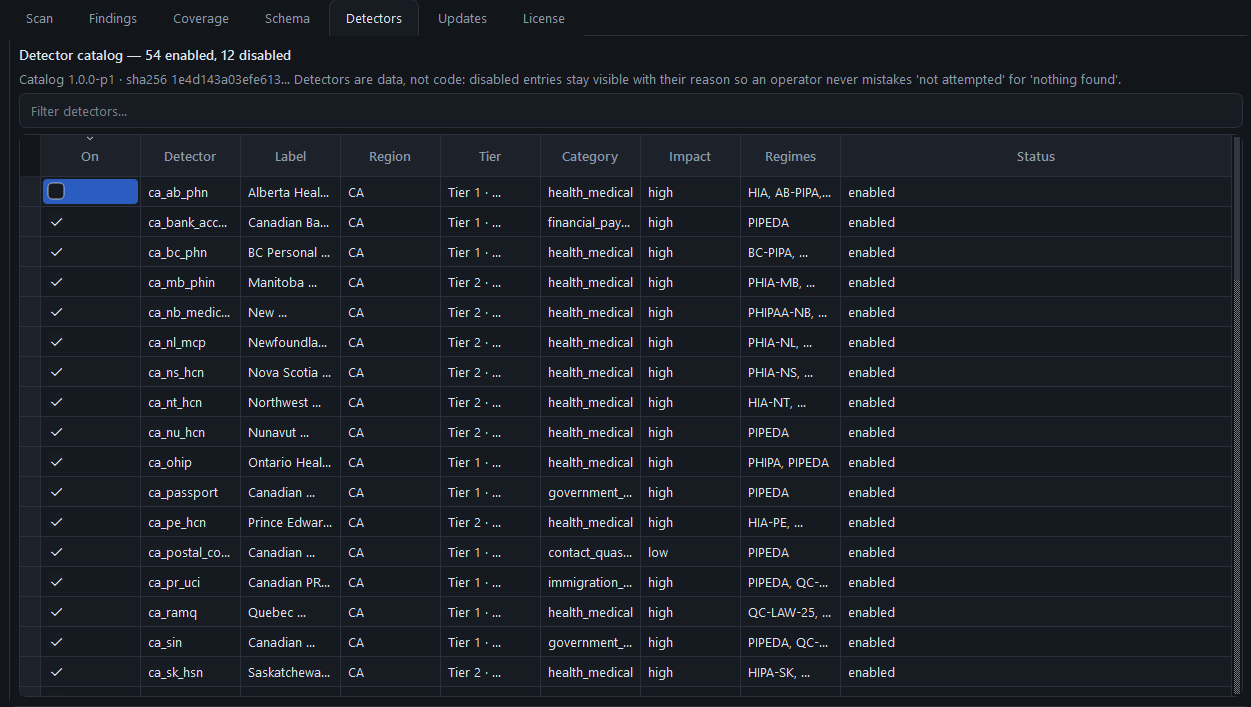
VellumSoft's US detectors include state driver's licences and the US passport number, and the Canadian passport number is a Tier 1, high-impact detector. The Region setting (US, CA or BOTH) limits detectors to the chosen jurisdictions, and findings show masked values by default.
Canadian driver's licences are the open point. This page covers US state licences and US and Canadian passports. Canadian driver's licence numbers are not covered here, and this page makes no claim that they are detected.
Three limits matter for ID documents:
- Most copies are pictures. OCR accuracy drops on handwriting and on low-resolution or skewed images, and a phone photo of a licence is often all three.
- Version 2.0.2 does not read Word (DOCX), Excel (XLSX), ZIP or 7z files, so an onboarding packet saved in one of those formats shows up on the Coverage tab as unread.
- VellumSoft does not redact or delete. Removing a scanned licence from a client file is done in the system that holds it.
A bare number without surrounding context is reported with a confidence score and not asserted as a match, which is the right behaviour for numbers with no checksum.
Other identifiers are under all detectors by country: Social Security numbers, Social Insurance Numbers (Social Insurance Numbers, with the SIN guide), Canadian health card numbers and the Ontario OHIP number. The steps of a scan are on how a scan works.
If a business in Canada finds a folder of photocopied licences, the commissioners' guidance suggests the better question is why the copies were made at all.
This page explains the law in general terms and is not legal advice.
Questions
Is a driver's licence number personal information?
Yes. Canada's privacy commissioners call the driver's licence number sensitive and valuable to those intent on committing identity crimes. In the United States, Massachusetts defines personal information to include a resident's name combined with a driver's license number or state-issued identification card number, and NIST lists both passport and driver's license numbers as examples of PII.
Can a store in Canada photocopy or record my driver's licence?
Usually it should not. The Office of the Privacy Commissioner of Canada says that, for the most part, privacy commissioners have concluded that writing down the licence number, or photocopying, swiping or otherwise reproducing the card, cannot be justified. Looking at the card, or recording the name and address on it, is normally enough.
Do passport and driver's licence numbers have a check digit?
Microsoft's published detector definitions for US driver's licence numbers, US and UK passport numbers, Canadian passport numbers and Canadian driver's licence numbers all list no checksum. A search for these numbers therefore depends on the number's shape and on nearby words such as passport or licence.
Are Canadian driver's licence numbers detected?
This page covers US state driver's licences, US passports and Canadian passports. Canadian driver's licence numbers are not covered here, and this page makes no claim that they are detected.
Sources
- Microsoft Learn, U.S. drivers license number entity definitionReviewed 16 Nov 2026
- Microsoft Learn, U.S./U.K. passport number entity definitionReviewed 16 Nov 2026
- Microsoft Learn, Canada passport number entity definitionReviewed 16 Nov 2026
- Microsoft Learn, Canada drivers license number entity definitionReviewed 16 Nov 2026
- AAMVA, 2020 DL/ID Card Design Standard (PDF)Reviewed 16 Nov 2026
- Office of the Privacy Commissioner of Canada, Protecting your driver's licenceReviewed 16 Nov 2026
- Massachusetts General Laws, Chapter 93H, Section 1, DefinitionsReviewed 16 Nov 2026