A privacy impact assessment, a data risk assessment and the privacy section of an IT risk assessment all open with the same question: what personal information is involved, how much, and where is it kept? Quebec's Act says the depth of an assessment depends on "the sensitivity of the information concerned", its quantity and distribution, and the medium on which it is stored1. A scan of the systems in scope answers that with evidence in place of an estimate.
Three kinds of assessment, one first question
| Assessment | Who must do it | When, or what it asks |
|---|---|---|
| Privacy impact assessment, Quebec private sector | Any person carrying on an enterprise1 | For any project to acquire, develop or overhaul an information system involving personal information, and before communicating personal information outside Quebec1 |
| Privacy impact assessment, Ontario provincial institutions | Institutions under FIPPA, since July 1, 20254 | Before collecting personal information, and before a significant change of purpose4 |
| Privacy impact assessment, federal institutions | Required by Treasury Board policy since 20023 | When personal information may be used in a decision that directly affects the individual, and on major changes3 |
| Data protection impact assessment, GDPR | The controller8 | Before processing that is likely to result in a high risk to people's rights and freedoms8 |
| Risk analysis, HIPAA | Covered entities and business associates6 | An "accurate and thorough assessment of the potential risks and vulnerabilities" to electronic protected health information6 |
| Risk assessment, FTC Safeguards Rule | Financial institutions7 | The basis of the information security program7 |
Every row needs a description of the data before any risk can be rated. Ontario's list of what a PIA must contain includes the types of personal information to be collected and the period for which it will be retained4. PIPEDA's safeguards principle says the level of protection depends on the sensitivity of the information, and on its amount, distribution, format and method of storage5. The GDPR row is cited to the version kept in United Kingdom law, the UK GDPR8.
Is there a PIPEDA privacy risk assessment?
Not by name. The phrase "impact assessment" does not appear in the text of PIPEDA5. Searches for a "PIPEDA DPIA" are borrowing the GDPR's term.
The expectation exists all the same. The privacy commissioners of Canada, Alberta and British Columbia say that "conducting risk assessments, at least on an annual basis, is an important part of any privacy management program"2. They add that organizations should develop a process for identifying and mitigating privacy and security risks, "including the use of privacy impact assessments and security threat risk assessments", and should treat those assessments as evergreen documents2.
Quebec is where a private business meets a hard requirement. Its Act says an enterprise "must conduct a privacy impact assessment" for a project to acquire, develop or overhaul an information system that handles personal information, and must consult its person in charge of the protection of personal information from the outset1. The Quebec Law 25 guide and the glossary entry on privacy impact assessments cover the rules.
What a data risk assessment is
A data risk assessment finds where sensitive information is kept, who can reach it, what could go wrong, and whether the safeguards are enough. The Safeguards Rule gives a compact version: a risk assessment that "identifies reasonably foreseeable internal and external risks" to customer information and assesses the sufficiency of the safeguards in place7.
An IT risk assessment covers more ground, since it also weighs outages and systems that hold no personal information. Its privacy section is the same exercise. The HIPAA version is described on the HIPAA risk analysis page.
What goes wrong when the data section is a guess
Assessments are usually written by the project team, from what the team believes the system holds. A clinic moving its shared drive to a cloud service writes that the drive holds "administrative documents". Nobody opens the folders. The drive also holds a decade of scanned referral letters, a CSV of health card numbers exported for a billing fix, and a mailbox archive from a physician who left.
The assessment that follows rates the move as low risk, picks safeguards to match, and is signed. Every later step inherits the mistake. The OPC warns against exactly this kind of document, listing among the things a PIA is not: "a superficial legal checklist" and "a justification for policies already decided"3.
How a scan supplies the evidence
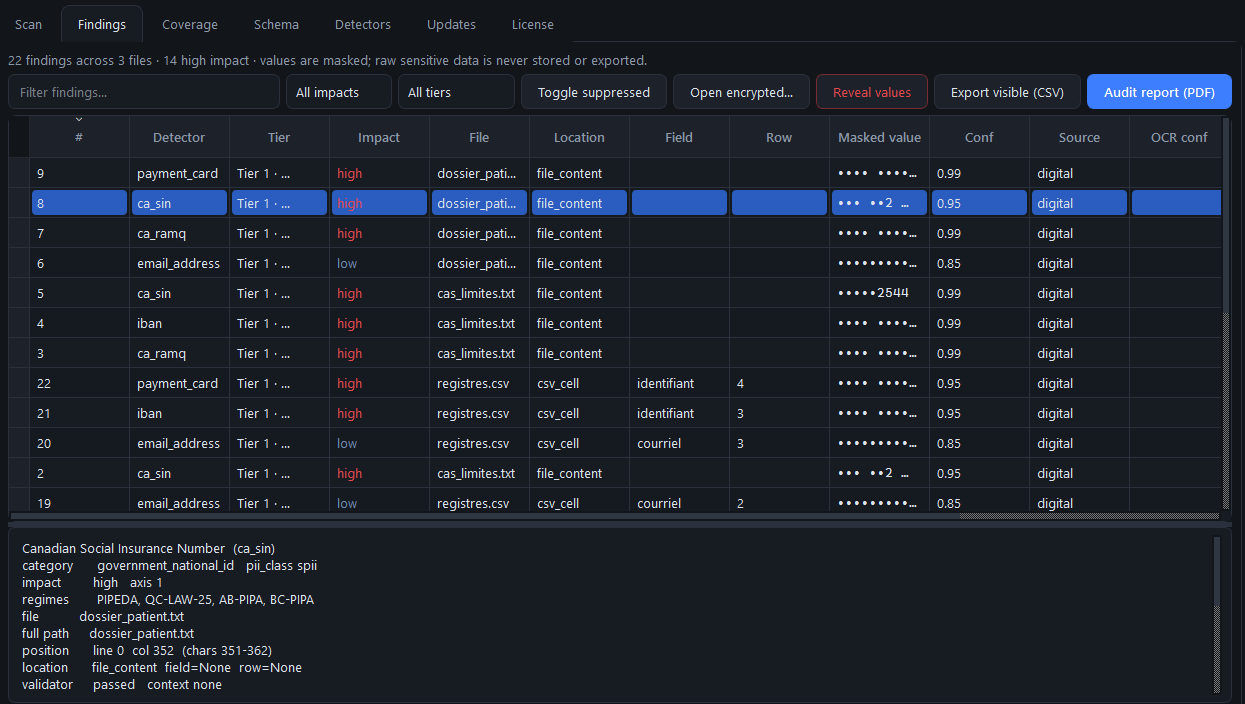
This is the first of VellumSoft's typical uses: before a privacy impact assessment or audit, to map where personal and health information has accumulated. The work goes in this order.
- Write down the scope of the assessment: which shares, folders, devices and mailbox exports the project touches.
- Scan those locations.
- Read what the scan could not open before reading what it found.
- Summarize the findings for the assessment: types of information, counts, and the locations that hold most of it.
- Rate the risks with those facts in hand, and choose safeguards.
- Attach the scan report to the assessment, with its date.
- Scan again after the project changes the systems, and update the assessment.
Each factor Quebec's Act names has a counterpart in the scan output1. Findings carry an impact level of high, moderate or low, which speaks to sensitivity. Counts per data type speak to quantity. File-level locations speak to distribution. Each finding is marked as read from digital text or by OCR from an image or scanned page, which speaks to the medium.
VellumSoft scans PST and email exports, documents and images for US and Canadian PII and PHI, and it runs locally, so the assessment itself sends no personal information to a new vendor. The how it works page covers the steps.
The data risk assessment report
The assessment needs an appendix a reviewer can check. The audit report is a PDF with an executive summary, the scan scope and timestamp, findings grouped by regulation with counts per data type, file-level locations, a coverage disclosure and a SHA-256 fingerprint of the results. It contains no raw values. That makes it suitable to attach, where a list of raw identifiers would create a new exposure.
It is not a data leak report. A scan shows where information sits. It does not show whether any of it left.
What the scan does not assess
The scan answers the factual question and leaves the judgment to people. It does not identify threats, estimate likelihood, test whether a collection is necessary or check legal authority. VellumSoft does not give legal advice or certify a data set as clean.
Coverage has limits that belong in the assessment as known gaps. Version 2.0.2 does not read Word (DOCX), Excel (XLSX), ZIP or 7z files. VellumSoft reads local files and .pst, .ost and .msg mail archives, and it does not connect to databases or to live cloud mailboxes. No scanner finds everything.
The same scan output feeds a personal data inventory, which the commissioners treat as the starting point of a privacy program2. It also supports breach scoping and checking PST files before a Microsoft 365 import.
An assessment that begins with what the system is believed to hold can be improved in an afternoon. Scan it, and write what it holds.
This page explains the law in general terms and is not legal advice.
Questions
What is a data risk assessment?
A review that finds where sensitive information is kept, who can reach it, what could go wrong and whether the safeguards in place are enough. The FTC Safeguards Rule describes the core of it: identify reasonably foreseeable internal and external risks to the security, confidentiality and integrity of the information, and assess the sufficiency of the safeguards that control them.
Does PIPEDA require a privacy impact assessment or DPIA?
The Act does not contain the phrase. Canada's privacy commissioners nonetheless expect organizations to assess risk at least annually and to use privacy impact assessments for new projects involving personal information. Quebec's private-sector Act goes further and makes an assessment mandatory for information system projects and for transfers of personal information outside Quebec.
What is the difference between an IT risk assessment and a privacy impact assessment?
An IT risk assessment asks what could harm the organization's systems and information. A privacy impact assessment asks what a project could do to the people the information is about, and whether the collection is lawful and necessary. Both need the same starting facts: what personal information is involved, how much, and where it is kept.
Is a scan report a data leak report?
No. A file scan shows where personal information sits at rest. It does not show whether anything left the organization. VellumSoft is a discovery tool and does not block or quarantine data. Evidence that data left comes from logs and forensic work.
Sources
- eCFR, 45 CFR 164.308, Administrative safeguardsReviewed 16 Nov 2026
- eCFR, 16 CFR Part 314, Standards for Safeguarding Customer InformationReviewed 16 Nov 2026