Cornell Spider and Virginia Tech's Find_SSNs are free scanners that universities wrote to find Social Security and card numbers on staff computers13. Find_SSNs can still be downloaded, though its download section was last updated in March 20091. Both universities now point staff to Spirion, a commercial product25. Today's free options are mostly code libraries and forensic tools. A paid desktop scanner suits a team that wants a finished tool and a report.
What Cornell Spider was
The University of Delaware still describes Spider on its software page as "an open-source forensic tool from Cornell University"3. It scans a hard drive, website or other collection of files for Social Security numbers, credit card account numbers and bank account routing numbers3. When a scan ends it lists the files that may hold confidential data, and the user reviews the log for false positives3. Delaware lists it for Mac and Windows and sends readers to Cornell's website for the download3.
An older page shows how one copy of Spider worked. A UMBC computer science wiki page, last edited in 2007, describes Spider as a file scanner driven by a list of regular expressions, and says the department's copy had been heavily modified4. In that copy a second list, called IGNORE, removed example data such as placeholder numbers from the matches4.
Cornell's main IT website refused the fetcher used for this page, so nothing here states whether Cornell still distributes Spider. One Cornell page did load. Cornell's TBE IT Support group tells its staff that "Spirion (also referred to as Identity Finder) is used to scan for confidential data" on Windows and Mac computers5. That page does not mention Spider5.
People also search for CUSpider. The Columbia University page about it refused the same fetcher, so nothing is claimed about CUSpider here.
What Find_SSNs does, in Virginia Tech's words
Find_SSNs "searches for U.S. social security and credit card numbers"1. Virginia Tech says it was built for anyone to run, and that on Windows nothing needs to be installed first1. The page is candid about limits. Find_SSNs "is not meant as a silver bullet", it does not secure the files it finds, and it may produce false positives and false negatives or miss some files altogether1.
The age shows in the details. The download section reads "Updated March 18th, 2009", and the Windows executable is listed as tested on Windows 7, Vista, XP, 2003 and 20001. By default it skips PDF files and files larger than 100 megabytes, and it cannot search encrypted files1.
One design choice has aged in a specific way. Virginia Tech says Find_SSNs uses Social Security Administration data to validate the relationship between a number's area and group digits, which cuts false positives1. SSA's operations manual says "Beginning June 25, 2011, we assign all SSNs randomly"14. The Find_SSNs download predates that change, and its page does not say how the validation treats numbers issued since1.
The report is the other caution. Virginia Tech tells users to "securely delete all of the Find_SSNs report files" after use, because the reports "are road maps to potentially sensitive information"1.
What replaced them at the universities
The universities that wrote the free tools now license a commercial one. Virginia Tech's sensitive data page says the university bought a site licence for Identity Finder, the earlier name of Spirion213. The Cornell page quoted above names Spirion as the scanning tool, and suggests Find SSNs only for Linux systems where the user has administrative rights5. Northwestern's list of tested search tools marks Spirion as its recommended product6.
For staff, the scanner is still free at the point of use. UW-Madison says its Spirion service is centrally funded and "available at no cost to you or your department"13. Outside a campus licence, Spirion is sold by archTIS, which completed its acquisition of Spirion in October 2025, and the Identity Finder and Spirion page covers what it sells today15.
One more university tool did carry on in another form. UT Austin's Sensitive Number Finder (SENF) runs on any operating system that supports Java, has a public GitHub repository, and UT Austin now sends inquiries about it to a partner company7.
Free PII scanners today
Each description below comes from the tool's own page. None of the tools was run for this article.
| Tool | What its own page says | A finished scanner for an office? |
|---|---|---|
| Find_SSNs | Searches files for U.S. Social Security and card numbers; download last updated March 20091 | Yes, for those two identifiers1 |
| SENF | Java suite that identifies SSNs, card numbers and similar numbers; its page states no price or licence7 | For technical staff; inquiries go to a partner company7 |
| Presidio | An open-source framework for detecting and anonymizing sensitive data in text and images, under the MIT licence8 | No. It is used from Python, Docker or Kubernetes8 |
| bulk_extractor | A "high-performance digital forensics exploitation tool" that pulls email addresses and card numbers out of disk images and files9 | No. The README says native Windows builds are not currently supported, though the project cross-compiles a Windows executable9 |
| Octopii | A Python scanner that uses OCR, regular expressions and NLP to find government IDs, addresses and emails in images and PDFs10 | No. It installs through pip and Tesseract on Linux10 |
| Trials of paid tools | PII Crawler runs free for 7 days, and DataSecurity Plus has a free edition capped at 100GB for data risk assessment1112 | Yes, within the limit1112 |
Three things stand out. Only the oldest tools were made for an office worker to run1. The maintained projects are building blocks for developers and forensic examiners89. And none of these pages names a Canadian Social Insurance Number or a provincial health number18910.
The free tools are also honest about certainty. Presidio's README warns that "there is no guarantee that Presidio will find all sensitive information"8.
Pick a free tool when
- The search is for U.S. Social Security and card numbers only, and someone technical will run it and check the results1.
- A developer is building PII detection or redaction into a pipeline. Presidio is made for that8.
- The work is forensic, on disk images. bulk_extractor is made for that9.
- The organization is a university with a campus Spirion licence, where the scanner is already paid for13.
- VellumSoft 2.0.2 does not read Word or Excel files, and those are what needs scanning. Virginia Tech says Find_SSNs searches both formats1.
Where a paid desktop scanner fits
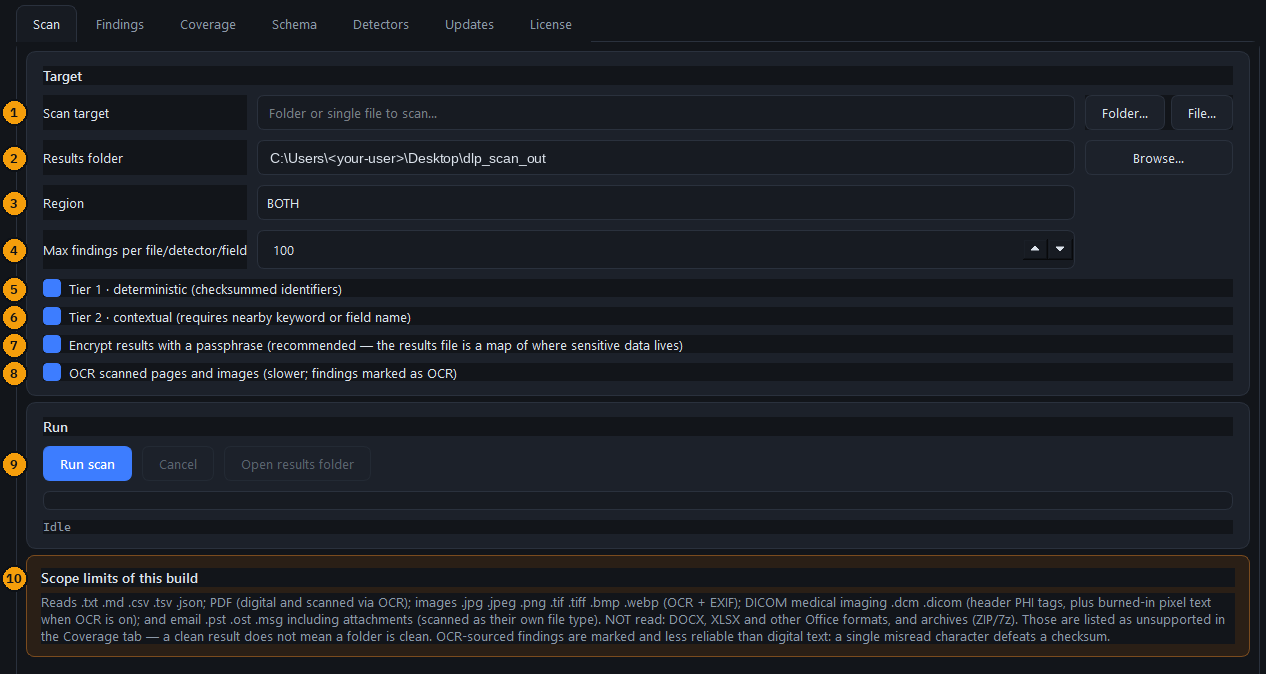
VellumSoft is an offline Windows scanner sold as a one-time purchase. VellumSoft Solo is $399 per seat and Team is $749. Three differences from the free tools matter most.
The first is the identifier list. VellumSoft looks for Canadian identifiers beside the US ones: the SIN, OHIP and RAMQ numbers, and health numbers for four western provinces. The detector list has the detail.
The second is the results. VellumSoft shows masked values by default and encrypts the results file with a passphrase. Virginia Tech's advice to delete plain-text reports is the problem that design answers1.
The third is the report. The audit PDF groups findings by regulation and carries a coverage disclosure of what was not read. The sample report page shows the layout.
The limits are just as plain. Version 2.0.2 does not read Word, Excel, ZIP or 7z files, runs on Windows only, and does not redact or delete. Its own line is "No scanner finds everything", which matches what the free tools say about themselves18.
Other comparisons
- PII scanners compared is the full list.
- VellumSoft vs PII Crawler: PII Crawler is an offline scanner for macOS, Windows and Linux11.
- Identity Finder and Spirion alternative for Windows: Spirion is an enterprise platform that archTIS acquired in 202515.
- Microsoft Purview alternative for on-prem PII scanning: the Purview scanner runs as a service on Windows Server16.
- VellumSoft vs PII Tools: PII Tools is a self-hosted platform priced from 2,000 USD a month, billed annually17.
This page compares published product claims in general terms and is not legal advice.
Questions
Can the old university SSN finders still be downloaded?
Virginia Tech still hosts Find_SSNs, with a Windows executable, source code and a Mac version1. Its download section says it was updated on March 18th, 20091. The University of Delaware's page for Spider sends readers to Cornell's website for the download3. Cornell's main IT site refused the fetcher used for this page, so the tool's status there is not confirmed here.
Do free scanners look for Canadian SINs or health card numbers?
None of the free tools' own pages reviewed for this article names a Canadian Social Insurance Number or a provincial health number. Find_SSNs searches for U.S. Social Security numbers and credit card numbers1. Presidio's README gives examples such as credit card numbers, social security numbers and US phone numbers, and says recognizers can be customized8.
Is a free trial the same as a free scanner?
No. PII Crawler offers its full product free for 7 days, after which scanning pauses until a licence is registered11. ManageEngine says DataSecurity Plus has a free edition in which the Data Risk Assessment module is limited to 100GB of data12. Both are ways to test a paid product.
Do free scanners produce a report for a privacy officer?
They produce lists and text files. Virginia Tech tells users to securely delete the Find_SSNs report files after use and not to store them as plain text, because they are road maps to sensitive information1. The bulk_extractor README says its results are stored in text files for inspection or further forensic processing9.
Sources
- Virginia Tech IT Security Office, Find SSNsReviewed 16 Nov 2026
- Virginia Tech IT Security Office, Protecting Sensitive DataReviewed 16 Nov 2026
- University of Delaware, UDeploy Software Distribution, SpiderReviewed 16 Nov 2026
- UMBC CSEE Documentation wiki, SpiderReviewed 16 Nov 2026
- Northwestern University IT, Using Sensitive Data Search ToolsReviewed 16 Nov 2026
- UT Austin Information Security Office, Sensitive Number Finder (SENF)Reviewed 16 Nov 2026
- GitHub, data-privacy-stack/presidio READMEReviewed 16 Nov 2026
- GitHub, simsong/bulk_extractor READMEReviewed 16 Nov 2026
- GitHub, redhuntlabs/Octopii READMEReviewed 16 Nov 2026
- PII Crawler, home pageReviewed 16 Nov 2026
- ManageEngine, DataSecurity Plus subscription pricing detailsReviewed 16 Nov 2026
- University of Wisconsin-Madison Information Technology, Data discovery (Spirion)Reviewed 16 Nov 2026
- archTIS, press release on the acquisition of SpirionReviewed 16 Nov 2026
- PII Tools, PricingReviewed 16 Nov 2026