A Quebec health insurance number (numéro d'assurance maladie, or NAM, often called the RAMQ number) is four letters followed by eight digits2. Quebec's health ministry describes it as the first three letters of the family name, the first letter of the first name, the last two digits of the birth year, the birth month, the birth day and an administrative code from the RAMQ1. For the female biological sex, 50 is added to the month1.
How to read a RAMQ number
The pattern below uses letters only. It is a pattern, not a number.
SSSF YYMM DDAA
| Position | What it holds | Source |
|---|---|---|
| SSS | First three letters of the family name | 1 |
| F | First letter of the first name | 1 |
| YY | Last two digits of the birth year | 1 |
| MM | Birth month, with 50 added for the female biological sex | 1 |
| DD | Birth day | 1 |
| AA | Administrative code of the RAMQ | 1 |
The ministry's own instruction to hospital staff shows how the month works. To record a patient's biological sex, staff are told to look at the birth month in the NAM, and if it is greater than 50 the sex is female1.
That rule became more visible on October 10, 2024, when the RAMQ began issuing cards with an X gender marker1. The ministry told the health network that adding the X on the card does not change the alphanumeric number called the NAM1. The card can say X while the number still carries the month rule.
A number that describes its holder
Ontario's ministry describes its health number only as an identifier, as the page on the Ontario OHIP number explains. The Quebec number is different. Anyone who knows the layout can read a date of birth and a sex from it, and can guess at the name.
This has a practical effect on old files. A column of RAMQ numbers with every other column deleted is still a column of birth dates. Masking the name beside a NAM does not remove the first four letters of it from the number.
Is there a check digit?
The ministry's fact sheet calls the last two digits the "code administratif de la RAMQ" and says nothing more about them1. No official page reviewed for this article publishes a check-digit formula for the NAM. The RAMQ's own website refused the fetcher, so its pages could not be read here.
The layout itself gives a structural test. The four leading characters must be letters and the next digits must form a real date, with a month that is either a calendar month or a calendar month plus 501. A string that fails that test is not a NAM. A string that passes it may still belong to nobody.
Where RAMQ numbers turn up in files
In a clinic, pharmacy or CLSC the number is on registration forms, billing records and lab results. Quebec files are often bilingual, so the label beside the number may read "NAM", "numéro d'assurance maladie", "RAMQ" or "health insurance number".
Outside health care the usual sources are employer group-insurance forms and registrations for daycare or camp. Photocopies of the card kept as identification are the other common one, and old mailbox exports hold many of them as attachments.
Who may ask for the card
Quebec's Health Insurance Act is direct. Under section 9.0.0.1, "No person may be required to produce a health insurance card or eligibility card" except for health or social services, goods or resources whose cost the government assumes in whole or in part3. Section 9.1 adds that no person may require or accept that an insured person "entrust, lend, give or sell his card to him"3.
For bodies in the health network, the Act respecting health and social services information (chapter R-22.1) counts a "health insurance number" as health and social services information when it appears with information about a person's health or care, or when it is collected to register or admit the person4. Private businesses in Quebec fall under the private-sector act instead, covered on the Quebec Law 25 page.
How the rules compare with Ontario, Alberta and Manitoba is set out in Canadian health card numbers by province.
Finding RAMQ numbers with VellumSoft
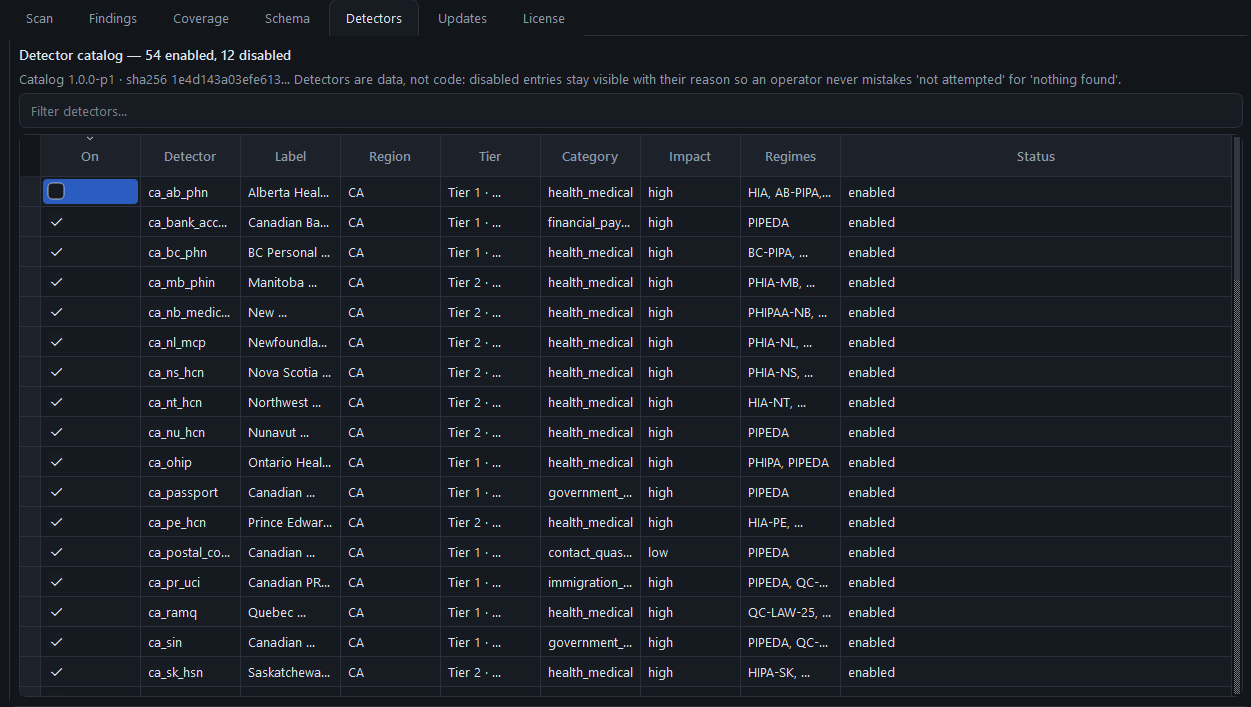
Québec (RAMQ) health numbers are among VellumSoft's Canadian identifiers. The RAMQ detector is Tier 1 and high impact, and a finding from it shows the detector label ca_ramq. A Tier 1 match must pass a mathematical or structural check.
VellumSoft reads context words in English and French, for example a column named "courriel". That matters for Quebec files, where the column heading is as likely to be French as English.
Two limits apply. Version 2.0.2 does not read Word (DOCX), Excel (XLSX), ZIP or 7z files, so a scan of a folder full of them says nothing about those files. Photocopied cards depend on OCR, and a single misread character defeats a checksum.
The steps of a scan are set out on the how it works page. Related pages cover Social Insurance Numbers, US Social Security numbers and the full detector list by country.
A RAMQ number tells a reader the holder's birth date and sex before any other field is opened1, which is a reason to treat every stray copy as personal information.
This page explains the law in general terms and is not legal advice.
Questions
How many characters are in a RAMQ number?
Twelve. A Quebec health insurance number, or NAM, is four letters followed by eight digits. The letters come from the holder's surname and first name, and the digits hold the birth year, month and day plus an administrative code assigned by the RAMQ.
What do the letters in a RAMQ number mean?
Quebec's health ministry describes them as the first three letters of the family name followed by the first letter of the first name. Because the letters come from the name, two unrelated people can share the same four letters, and the digits that follow tell them apart.
Why is the month in a RAMQ number higher than 12?
The ministry's fact sheet says 50 is added to the birth month for the female biological sex. If the month shown in the number is greater than 50, the sex recorded is female. A month of 12 or less means male.
Can a store or landlord in Quebec ask for a health insurance card?
No. The Health Insurance Act says no person may be required to produce a health insurance card except for health or social services, goods or resources whose cost the government assumes in whole or in part. The same Act bars anyone from requiring a cardholder to lend or hand over the card.
Sources
- LégisQuébec, Health Insurance Act, CQLR c A-29Reviewed 28 Oct 2026