A data subject access request (DSAR) obliges an organization to tell a person what information it holds about them and to give them access to it, on a deadline. PIPEDA allows thirty days, EU guidance one month and California 45 days134. The search is the hard step. A file scan does not pick out one named person. It shows which stores hold personal identifiers, so the search for that person is less likely to leave one out.
The right of access and its deadlines
| Law | Time to respond | Extension |
|---|---|---|
| PIPEDA, section 8 and clause 4.91 | "Not later than thirty days after receipt of the request"1 | A maximum of thirty days more on two stated grounds, or the period needed to convert the information into an alternative format, with a notice of extension sent within the first thirty days1 |
| EU GDPR, as explained by the European Data Protection Board3 | "Within one month of receipt of the request"3 | Two further months where necessary3 |
| California Consumer Privacy Act4 | "Within 45 days of receiving a verifiable consumer request"4 | Once, by an additional 45 days when reasonably necessary4 |
| HIPAA, 45 CFR 164.5245 | No later than 30 days after receipt of the request5 | No more than 30 days5 |
PIPEDA's access principle starts with a plain duty: "Upon request, an organization shall inform an individual whether or not the organization holds personal information about the individual"1. A missed deadline has a consequence written into the Act. An organization that fails to respond in time "is deemed to have refused the request"1.
The Privacy Commissioner's guidance closes one loophole. "You cannot simply acknowledge within 30 days that you received the request, and then take more time to actually deal with it"2.
The DSAR process, step by step
- Log the request and the date it arrived. Under PIPEDA it must be in writing1.
- Confirm who is asking. PIPEDA lets an organization require enough information to provide an account, and the OPC says more may be needed "to verify his or her identity or to locate the information"12.
- List every store that could hold the person's information.
- Search those stores for the person's name and identifiers.
- Review what was found, including information about other people and any exemption that applies.
- Respond in an understandable form. PIPEDA says access is given "at minimal or no cost to the individual"1.
- Keep a record of what was searched and what was sent.
Securiti's version of this process has ten steps, and locating and accessing data sources is the third6. That step assumes the organization already knows where its data sources are.
Why the search is the hard step
The European Data Protection Board states the scope bluntly: "The controller will have to search for personal data throughout all IT systems and non-IT filing systems"3. The customer database is the easy part. The same person may also appear in a mailbox export from a former employee, in a scanned application form saved as an image, and in a CSV somebody exported for a mail merge.
An organization that has never mapped those stores will search the systems it knows about and answer in good faith. The answer will still be incomplete.
What a file scan adds, and what it does not
The limit comes first. VellumSoft 2.0.2 does not search for one named person. Its detectors recognize types of identifier, such as Social Insurance Numbers and health card numbers, and findings show masked values by default. A text filter over the findings table matches detector IDs and file names. Treat it as a filter for detectors and files, not as a search for a person's name or a full identifier.
What a scan does contribute is the map that step three needs.
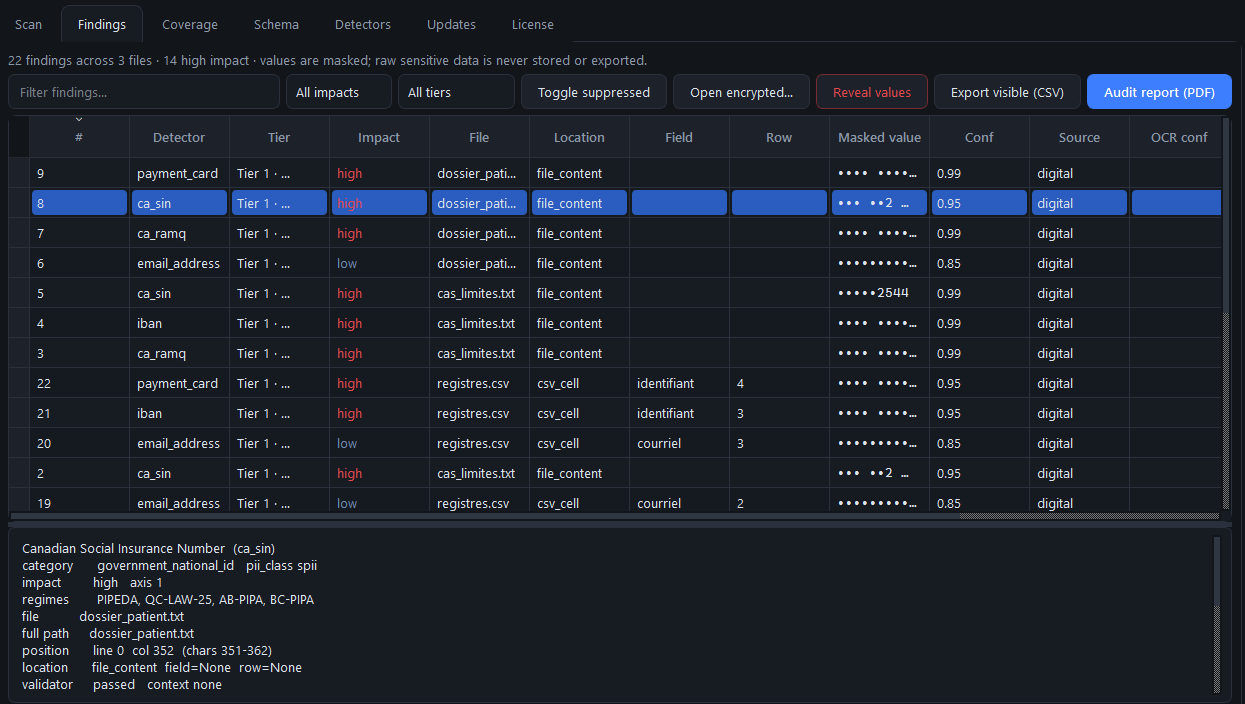
- A list of stores that hold personal data. VellumSoft reports counts, file paths and data types. Each path on that list is a place the person-level search must cover.
- Scanned paper. VellumSoft reads scanned PDF pages and images by OCR when OCR is on. A name search in a file manager cannot see inside an image, so these files are the ones a manual search skips.
- Mail archives. VellumSoft reads
.pst,.ostand.msgfiles, with each attachment scanned as its own file type, and a mail finding shows the folder, the sender and the subject. That narrows which archives to open. - A record of scope. The audit report states what was scanned and includes a coverage disclosure. That supports step seven.
The person-level search then runs in other tools: the mail client, the document system, a desktop search, over the shortlist the scan produced.
Some products do offer a search by person. PII Crawler's documentation describes an identity scan that "links findings to names" as the phase to run for a DSAR7. PII Tools gives the query "Show me all the locations where we keep information on John Smith" as an example of what a discovery tool should answer8. A team that handles access requests every week should look at tools of that kind.
Two further limits apply. Version 2.0.2 does not read Word (DOCX), Excel (XLSX), ZIP or 7z files, so correspondence in those formats is outside the map until it is converted. And VellumSoft does not connect to databases or to live Microsoft 365 mailboxes.
Before the next request arrives
Thirty days is short when the first part of it goes on finding out where to look. The work that makes a DSAR manageable is done earlier: a personal data inventory built from a scan, kept current, with the PII inventory template as the place to hold it.
Related pages cover finding ePHI for a HIPAA risk analysis, breach scoping and scanning PST files before a Microsoft 365 import. The how it works page sets out a scan from scope to report.
An access request tests the inventory. If the list of stores exists, the search has somewhere to start. If it does not, the deadline tends to arrive first.
This page explains the law in general terms and is not legal advice.
Questions
What is the time limit for responding to a DSAR?
It depends on the law. PIPEDA says not later than thirty days after receipt, with a possible extension. The European Data Protection Board says within one month, extendable by two further months. California's statute says within 45 days, extendable once by an additional 45 days.
Does an access request have to be in writing?
Under PIPEDA, yes: a request under the access principle must be made in writing, and the organization must help anyone who says they need assistance preparing it. The Privacy Commissioner adds that the organization may need to ask for more information to verify identity or to locate the information.
Does a DSAR cover old email archives and scanned paper?
The European Data Protection Board says a controller will have to search for personal data throughout all IT systems and non-IT filing systems. PIPEDA's access principle speaks of the personal information an organization holds, and its listed exceptions do not mention the age of a record. An old mailbox export on a shared drive is still information the organization holds.
Is VellumSoft a DSAR search tool?
No. VellumSoft does not search for one named person. Its detectors look for types of identifier, and it reports the files that hold them, which helps decide where a person-level search has to look.
Sources
- eCFR, 45 CFR 164.524, Access of individuals to protected health informationReviewed 16 Nov 2026
- Securiti, 10 Steps to Complete the DSAR ProcessReviewed 16 Nov 2026
- PII Crawler Docs, DSAR WalkthroughReviewed 16 Nov 2026
- PII Tools, Top Features to Look For When Comparing Data Discovery ToolsReviewed 16 Nov 2026